
Bar Renovation 100 Questions: A Veteran's Crash Notes and Honest Thoughts
When I was preparing to open a bar, I did what most people do—first I browsed Zhihu for “Bar renovation precautions,” wrote down each question, and thought that memorizing those answers would let me open smoothly. The result? With a 300,000 budget, I ran out halfway through; the lighting was finished but guests couldn’t stay seated; a week before the fire inspection I realized the sprinkler system hadn’t been updated. Looking back, I realized that asking questions isn’t wrong, but the way I asked them was, and all the answers were traps. This article won’t repeat what you can find on Baidu; I’ll share the lessons I learned with real money and a few sincere words.
Budget Section – “Is 100,000 enough?” Is Never a Good Question
When I first made a budget, my most common opening line to the renovation company was “Can I finish with 300,000?” They nodded rapidly, and after signing the contract I discovered the quotation only covered basic hard construction; fire approval, soundproofing, lighting equipment, sound system, and soft furniture were all listed under “optional add‑ons.” When the construction crew arrived to modify fire pipelines, the approval fee plus construction fee added another 80,000.
In a first‑tier city, a 200–300 m² medium‑size bar’s actual landed cost median is about 600,000–900,000. Design fees usually take 80,000–150,000, construction fees 200,000–300,000, but the biggest expense is equipment—lighting systems alone consume 25%–35%. You might think once the hard construction is paid for you’re done, but each of the sound system, smart control, and audio‑visual sync systems starts at five figures.
I also fell into a trap: the “price per square meter” on the quotation. After talking with a few peers, I learned that number can be made very low (e.g., excluding demolition, not including weak‑current electrical work). It looks cheap, but the price difference is covered later. My suggestion: after you receive the original quotation, ask the designer to break out the six items—design fee, construction fee, lighting equipment, fire approval, soft furniture, sound system—each with model numbers and quantities clearly listed. Only then does a price comparison make sense.
Design Section – Lighting Is Not Just “Add a Few Spotlights”
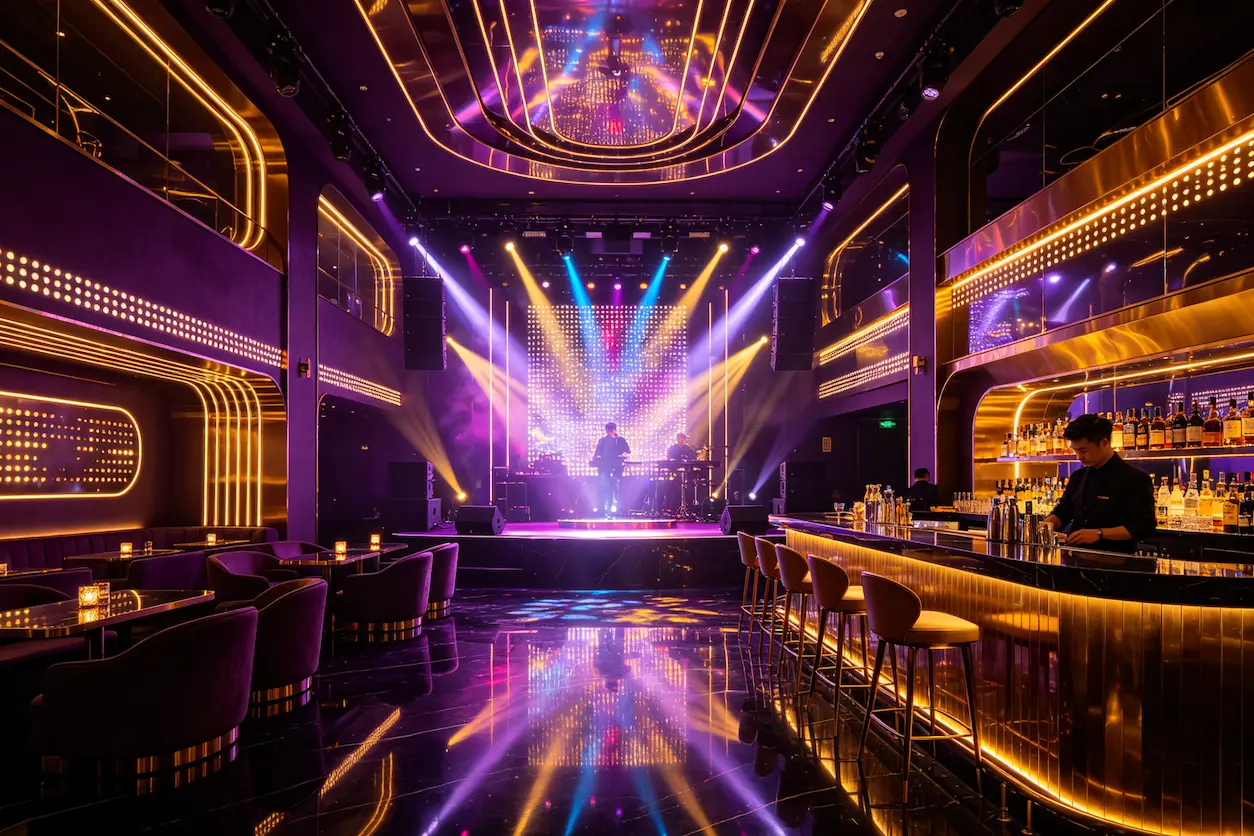
Before renovation I browsed many Xiaohongshu effect pictures and saw a bar with a premium purple‑blue lighting ambience, so I bought a dozen RGB strips and a few moving‑head lights and had the electrician install them. In the first week after opening, friends said it looked great, but by the third week guests started writing in reviews, “The lights are too glaring; I want to leave after half an hour.” I held on for three months, but turnover and average ticket never improved, so I decided to scrap it and redo.
The redo cost over 80,000, more than double what a proper professional design would have cost. I later understood that lighting design isn’t just picking fixtures; you need zoning, color temperature, illuminance, and smart integration. The bar counter area needs about 3500 K warm light to highlight bottle textures; booth areas drop to 2500 K for intimacy; the dance floor suits high‑saturation RGBW color‑changing lights—one set of lights blasting at full intensity looks like a car wash.
The second time I hired a full‑lighting design team and used aVYLEN’s one‑stop solution, from space modeling to lighting layout to audio‑visual sync, all handled by them. I saved myself the effort of watching Bilibili tutorials on DMX512 protocol and wiring the central control system. Those professional fixtures’ interactivity, scene presets, and audio‑visual sync are hard to achieve through self‑learning.
I’ve seen industry data: 60% of bars redo their lighting layout within three months after opening, and this extra cost accounts for 10%–20% of the original budget. In other words, skimping on lighting design fees during renovation ends up costing more in wasted money.
Moreover, lighting isn’t decoration—it’s an invisible salesperson for the bar. Good lighting ambience makes guests stay longer, order more rounds, and even post photos on social media, indirectly boosting turnover and organic traffic. If you’re still debating whether a lighting budget is worth it, check out this analysis of the five common bar lighting design techniques, which includes lighting logic for different scenarios.
Construction Section – You Thought Watching the Site Was Enough?
Before the electrical and plumbing crew arrived, I was overly confident, wearing a hard hat every day, taking photos and posting them on social media, thinking that supervising the site would prevent big problems. On the day the sound system arrived, we discovered that the wall had no pre‑installed audio and signal cables, and the power outlet was a full 1.5 m away from the bar’s reserved spot. The crew said “we can run surface wiring,” but surface wiring doesn’t pass commercial inspection. We had to partially dismantle the ceiling to re‑wire, pushing the schedule back another two weeks.
Soundproofing is another often‑overlooked element. My bar’s downstairs neighbor is a milk‑tea shop, upstairs is an open office area, and we received three complaints in the first month. Acoustic mats and vibration pads need to be embedded in the wall structure during the hard‑construction phase; adding a sound‑proof layer after construction at least doubles the cost.
My fire inspection experience was even worse—I didn’t know that sprinkler heads and smoke detectors must be offset from lighting fixtures. On inspection day, the fire team said the ceiling lights blocked the sprinkler coverage, so I had to modify it. That week I was simultaneously sending out a delayed opening notice and hiring an emergency fire‑modification company.
From my experience, the average construction period is four months, but 80% of projects overrun by one to two months. The three stages most prone to issues are electrical/plumbing reservation, fire modifications, and soft‑furniture installation. If you just received a shell or are planning a renovation, read the full bar‑renovation process from site selection to opening; it contains a more detailed timeline and checklist.
Opening Section – Inspection Is Not the End; Testing Is the Real Devil
After finishing the renovation I thought everything was fine and posted “Opening next Friday!” on social media. In the first three days, during the first system integration test, the lighting and sound were completely out of sync—DJ played a fast track while the lights were still doing a slow fade, making the atmosphere awkward enough that even the staff laughed.
I spent two whole days fixing DMX signal latency because the distance from the central controller to the last row of lights exceeded 50 m, causing signal attenuation and packet loss for moving‑head lights. The sound system’s squeal occurred in the third‑floor VIP area; no acoustic calculations were done, and low‑frequency standing waves made the whole room hum.
In the first month of opening, lighting equipment failure rates average about 15%, but devices that have undergone system integration testing and stress testing can reduce that to under 3%. The purpose of testing isn’t just “does it work,” but to expose every possible failure point before opening.
The lighting team I hired for opening provided on‑site support; VYLEN sent engineers for three days of lighting and sound integration testing, and they stayed two nights during the opening week to confirm scene switches were bug‑free. This service isn’t as prominently listed on a hard‑construction quote, but it’s crucial for a new owner unfamiliar with control systems.
Bars that skip stress testing and rush to open often have to close for repairs within the first week. Trust me, guests won’t forgive tonight’s bad experience just because you’ll “fix it tomorrow.”
FAQ
How much does a bar renovation usually cost? What should I ask when budgeting?
For a 200–300 m² bar, the landed cost is typically 600,000–900,000. The key is to clarify exactly what’s included in the quote. Ask the renovation company to break out the six items—design fee, construction fee, lighting equipment, fire approval, soft furniture, sound system—rather than accepting a “single‑price package.”
Is professional lighting design mandatory? Can I just buy popular online lights?
You can buy the lights yourself, but you’ll probably redo them within three months of opening. Lighting involves color temperature zoning, DMX signal distribution, and smart scene programming; a DIY setup rarely meets commercial operational standards. Skipping design fees often costs an extra 10%–20% in rework.
What is a normal construction timeline? How can I tell if the contractor is dragging?
Normal timeline is 3–5 months. Check whether the contractor provides a milestone schedule—how many days for plumbing/electrical routing, wall and floor work, equipment installation. If they only say “about two months,” they’re probably dragging.
Is renovating an old bar more trouble than building a new one? What should I watch out for?
Yes, it’s more complicated. Old walls may have hidden conduits, the ceiling’s load‑bearing capacity, fire system upgrades—none of which are known until you tear down. For renovation budgets, add an extra 15%–20% contingency for unforeseen issues.
What tests should be done before opening? What happens if I skip testing and open?
Perform lighting and sound integration, DMX latency testing, acoustic squeal checks, and stress testing (full load for two hours). Skipping testing usually results in lighting‑sound sync issues, sound squeals, equipment crashes, and other failures in the first week, making it hard to recover the guests’ first impression.
Share Article