
Low-Cost Renovation for Newly Opened Bars: Three Key Break-Even Points

A bar owner in Beijing’s Xicheng District spent 120,000 yuan in the spring of 2024 on the first round of hard‑fit renovation AI lighting preview saves three months. Three months after the renovation was completed, he abandoned that design and hired a new construction crew. The reason was simple—average spend per customer dropped from 52 yuan to 48 yuan, and the extra hard‑fit cost did not translate into any pricing power.
This is not an isolated case. The most common pitfall in a new bar’s first renovation is spending money on things that customers neither see nor are willing to pay for. Complex ceiling designs, expensive wall materials, custom fixed furniture—these often become silent costs on the books after two months of operation.
The core logic of low‑cost renovation is not “saving money” but shifting spending from places customers don’t see to places they want to photograph. Investments in lighting systems, entrance visual points, and social media photo spots boost average spend more directly than any hard‑fit material. Whether the renovation can break even within three months depends on three critical points: whether the budget allocation focuses on photo‑ready elements, whether the renovation methods choose fast‑impact items, and whether the construction pace is compressed to the limit. Once these three points are addressed, the final step is the accounting—calculating the post‑renovation pricing strategy and break‑even timeline.
Renovation Budget Allocation: Stake Limited Funds on “Photo‑Ready” Areas
A new bar’s renovation budget typically ranges from 30,000 to 50,000 yuan. How this money is spent directly determines whether prices can be raised after the renovation. Traditional renovation thinking tells you: start with the ceiling, then wall panels, and finally furniture. But if you only have 30,000 yuan, this sequence will fill your budget entirely with hard‑fit, leaving you with the same fluorescent lighting and an old sign at the entrance.
The correct allocation order should be: lighting system first. Lighting is the most direct expression of a space’s ambiance. With the same walls and floor, adjusting the color temperature from 3000 K to 4000 K and adding a few RGB wash lights instantly elevates the perceived tier of the space. The NEBULA bar case illustrates this well—its immersive light‑and‑shadow matrix combined with an intelligent dimming system vaulted it onto the local hot list in its first week, with an average daily footfall exceeding 300 people. This result was not achieved by wall materials but by the lighting system.
The second priority is the entrance visual point. The signage and illuminated letters at the entrance provide the first impression before customers step inside. A well‑designed illuminated entrance can prompt passersby to pull out their phones and take photos, providing free online promotion. The third priority is social media photo spots—bar counter area, background wall, corner seating—select two to three locations to create photo points, using lighting and props to create visual layers.
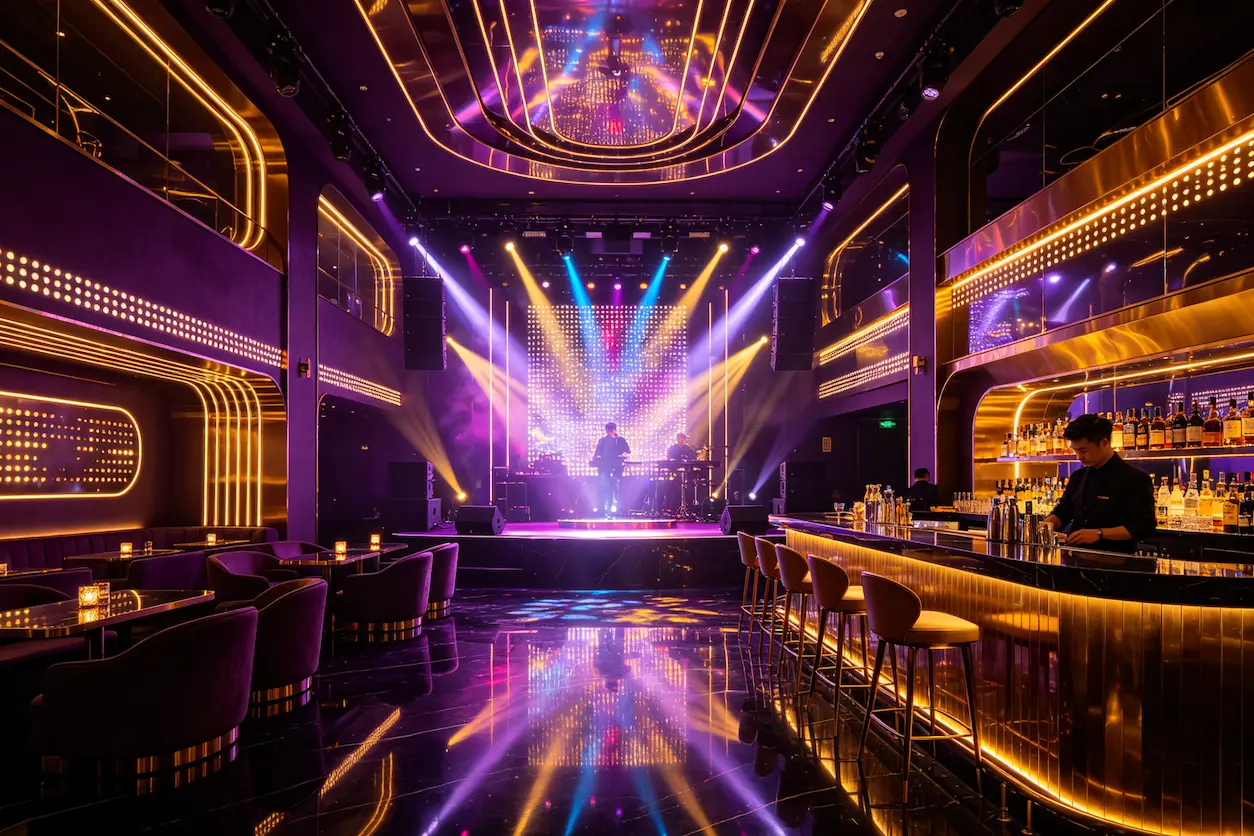
One expense that can be cut outright is a complex ceiling. For community‑style bars, a bare ceiling painted dark, combined with pendant lights and track spotlights, yields a far better effect than spending tens of thousands on plasterboard designs. Another cost saving is expensive wall materials—using artistic paint or wall fabric instead of stone and wall panels can reduce costs by over 60% with little visual difference. The shift in renovation budgeting thinking can be summed up in one sentence: the backdrop where customers take photos is more important than the chair they sit on.
Three Fast‑Impact Low‑Cost Renovation Measures: Walls, Lighting, Light Boxes
Without tearing down walls or ceilings, the three fastest ways to change a space’s ambiance are wall renovation, lighting system upgrade, and installing light boxes and illuminated letters.
Wall renovation is the most cost‑effective starting point. No need to scrape and redo wall plaster; simply apply artistic paint or micro‑cement on the existing wall, keeping the per‑square‑meter cost between 60 and 120 yuan, and it can be completed in two days. If the wall condition is decent, using wall fabric or custom wall stickers reduces cost further and shortens the timeline.
Lighting system upgrade is the key step to increase average spend Three lessons after renovating an old bar. A basic RGB + DMX control system with five to eight fixtures costs between 5,000 and 8,000 yuan, with a construction period of three to five days. A stage lighting system can use mobile light rigs, avoiding pre‑wired lines and minimizing damage to the existing space.
Light boxes and illuminated letters are the most direct low‑cost visual anchors. A double‑sided illuminated light box costs between 800 and 2,000 yuan, arrives three days after ordering, and can be installed by oneself. Placed at the entrance or behind the bar counter, it instantly creates a visual focal point. If you’re looking for design inspiration, refer to the specialty bar design case studies for practical applications—there are many light boxes and illuminated letters deployed in spaces of various scales.
Movable modular furniture is a fast‑impact item often overlooked in renovations. Custom fixed furniture has long lead times and high costs, and once installed cannot be moved. Modular sofas, detachable seating, and mobile bar counters can be set up within a day and later adjusted flexibly according to customer flow.
| Renovation Measure | Cost per sqm (yuan) | Construction Period | Sensory Dimension Affected | Break‑Even Driver |
|---|---|---|---|---|
| Wall renovation | 60‑120 | 2‑3 days | Visual, tactile | Spatial quality upgrade, photo rate increase |
| Lighting system | 200‑500 | 3‑5 days | Visual, atmosphere | Supports average spend, nighttime attraction |
| Light box/illuminated letters | 300‑800 (each) | 1‑2 days | Visual, brand recognition | Photo sharing, online traffic |
| Movable modular furniture | 150‑400 | 1‑2 days | Layout, function | High post‑renovation utilization, flexible adjustment |
These four measures do not conflict and can be combined. However, with a limited budget, the priority order is: lighting system first, then light boxes/illuminated letters, followed by wall renovation and modular furniture.
Construction Pace Management: Shortening Closed‑Door Time Saves Money
For a newly opened bar, each day the door is closed equals a day of revenue loss Specialty Bar Design Cases, plus the risk of losing regular customers. Therefore, managing the renovation pace directly affects the break‑even speed. Ideally, a low‑cost renovation that does not involve electrical or plumbing changes should be completed within ten days. This requires three conditions: lighting debugging and equipment installation proceed in parallel, nighttime construction is scheduled separately from daytime operation, and all materials are on site before work begins.
In practice, there are two most common causes of renovation delays. The first is repeated lighting debugging. Anyone with renovation experience knows that a lighting design that looks perfect on CAD and renderings can be completely different in reality. Beam angles, color temperature combinations, and brightness balance often require back‑and‑forth adjustments on site. A bar in Shenzhen’s Nanshan District encountered a typical lighting debugging issue during renovation: the design looked logically complete on CAD, but after installation, wall wash lighting was uneven, the bar counter area was under‑lit, and spotlights on the dance floor overlapped. Following the traditional approach, the project manager and the lighting manufacturer adjusted each fixture on site, taking three weeks to barely achieve an acceptable result.
During the lighting debugging phase, this Shenzhen bar used the AI lighting preview system provided by VYLEN, compressing the originally planned three‑week debugging period to four days. This is not an exception—lighting debugging is often the biggest time black hole in renovation projects. We have performed a detailed breakdown of the actual effects of AI lighting preview in a dedicated case analysis, which records pre‑ and post‑debugging data and on‑site comparisons.
The second common delay cause is a chaotic entry sequence. Bringing in furniture before walls are dry, or sealing the ceiling before lighting conduit is completed—these order mistakes cause rework and add three to five days to the schedule. A standardized entry sequence is clearly outlined in a comprehensive renovation process review, with explicit precedence constraints from demolition to soft‑fit installation.
A standardized construction process is severely undervalued for small new stores. Many renovation delays are not due to lazy crews but because no one manages the schedule. If you oversee the site yourself, it’s advisable to list daily construction tasks in a table before starting, and have workers confirm the day’s deliverables each morning—this sounds basic, but it truly can save at least two days of closed‑door time.
Post‑Renovation Pricing and Break‑Even Calculation
After renovation, the first thing is not to post on social media but to adjust the pricing strategy. Renovation is not merely to make the space look better, but to support a higher average spend.
Take a community bar in Beijing as an example: a renovation investment of 50,000 yuan raised the average spend from 45 yuan to 68 yuan, with an average daily footfall of 80 people. Simple math: a 23‑yuan difference times 80 people times 30 days yields an additional monthly revenue of about 55,000 yuan. Subtracting the renovation cost, the break‑even period is roughly four months. A key variable in this case is the repeat‑purchase rate increase from lighting upgrades. Lighting ambiance directly affects how long customers stay and their willingness to return. The case of a quiet bar in a Shenzhen alley is very persuasive—an industrial‑style framework paired with warm lighting scenes resulted in a post‑renovation repeat‑purchase rate exceeding 70%, ranking among the top three in the area.
Post‑renovation pricing should have a trial period. In the first two weeks, avoid an immediate price hike; instead, let regular customers naturally notice the change through new space experience events, then gradually adjust prices. Sudden price increases can cause a cliff‑like drop in repeat‑purchase rates, which is a direct cause of many renovation failures. Detailed discussions on how to back‑calculate pricing from renovation investment and how to design the drink menu to match the new space’s tier are included in the summary of lessons from old bar renovations.
Before performing the break‑even calculation, the VYLEN 2026 Space Renovation Handbook provides a complete business calculation template, with formulas and reference cases covering investment breakdown and recovery periods. The handbook’s evaluation includes a detailed explanation of the calculation logic, worth reviewing before finalizing a plan.
Note that the post‑renovation break‑even period is highly correlated with pre‑renovation foot traffic. If the average daily visitors are below 40, simply raising prices through renovation is unlikely to break even within six months—under such circumstances, first address the traffic issue before considering renovation.
Frequently Asked Questions
Q1: What is the minimum renovation budget needed?
30,000 yuan is the baseline for low‑cost renovation of a community bar in Beijing. This budget covers lighting system upgrades, illuminated entrance signage, wall renovation, and modular furniture replacement, with the remainder reserved for unforeseen expenses. Renovations below 20,000 yuan rarely produce perceptible sensory differences, so it is not advisable to take that risk.
Q2: Can a renovation be effective without changing the floor and ceiling?
Yes. The floor can be covered with carpet or partial tiling, and the ceiling can be painted dark and equipped with track lighting to shift the visual focus. Most customers, upon entering, notice the walls and bar counter area rather than the floor or ceiling.
Q3: How to reduce downtime losses during renovation?
Keep the closure time within ten days. If a full closure is impossible, renovate in zones—start with the bar counter and entrance, then gradually remodel the seating area. Additionally, notify regular customers through community groups a week before renovation and offer special pre‑sale vouchers during the closure to secure post‑renovation patronage.
Q4: Does lighting programming require hiring an additional professional team?
If you lack lighting debugging experience, it is advisable to have the lighting supplier or design team program the main scene modes in one go and lock the parameters. DIY programming can quickly become chaotic; many bars turn off the automatic lighting mode within six months after renovation and revert to manual switches, thereby losing the commercial value of the lighting system.
Q5: What if the renovation results fall short of expectations?
First, check whether the lighting has been fully tuned. More than 70% of unsatisfactory cases stem from lighting issues rather than hard‑fit problems. Next, allow a two‑week operational buffer for the space so that lighting, music, and staff flow can synchronize. If dissatisfaction persists after two weeks, use movable props and soft‑fit adjustments for localized fixes, which is the lowest‑cost remedy.
Share Article