
Limited Lighting Budget for Small Bars? Sophistication Isn’t About Throwing Money at It
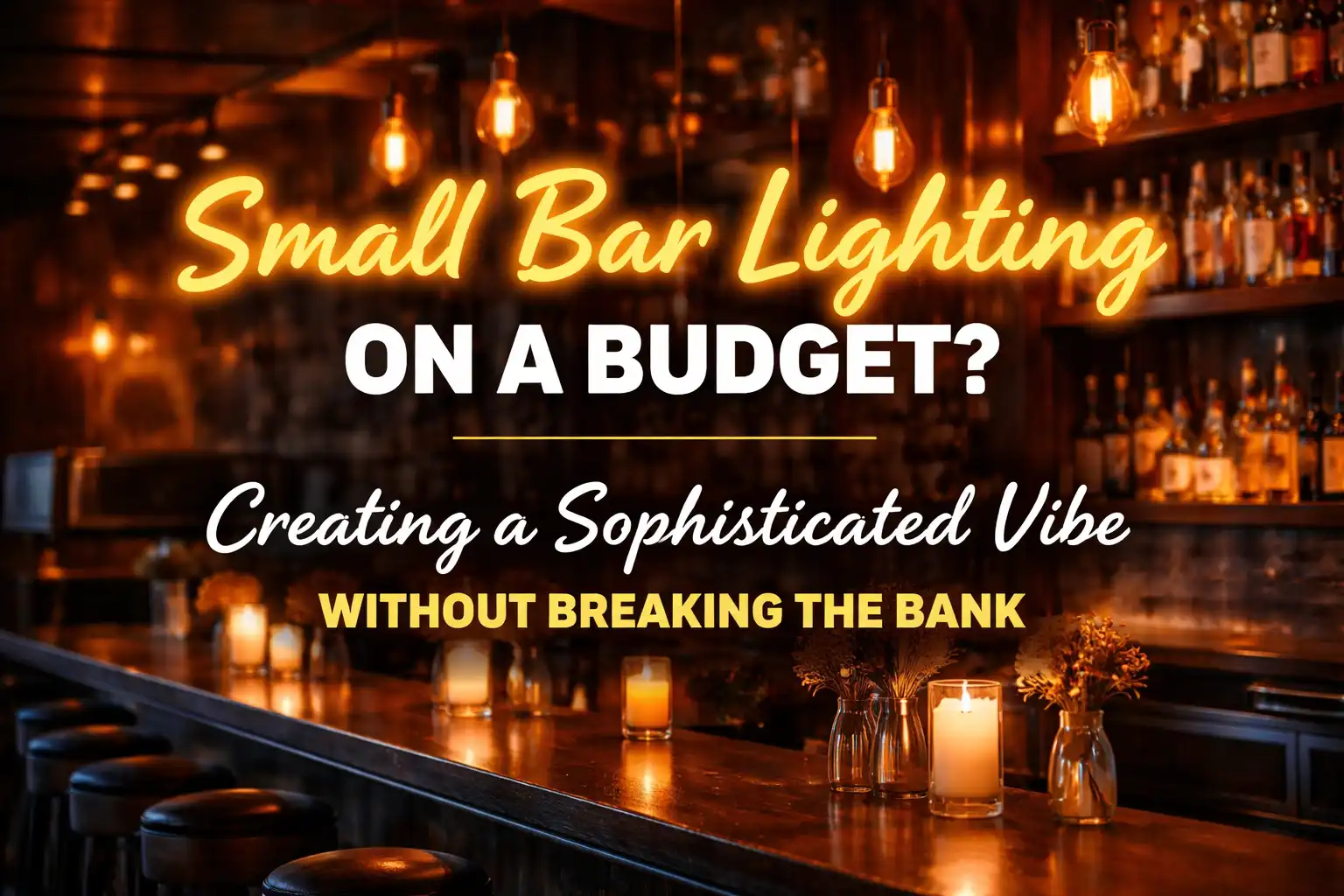
Lighting is the skeleton of a bar’s atmosphere. This sentence is almost cliché in the industry, yet there are few who can get it right when the budget is tight.
In the past two years, we have been involved in the design and implementation of a dozen small bars and KTV venues, with initial budgets ranging from a few hundred thousand to several hundred thousand yuan. A recurring phenomenon is that owners spend a lot on the renovation—hard‑goods materials, furniture, soft décor—but the lighting is either severely cut back or handed over to ordinary electricians unfamiliar with nightlife venues. The result is a first night that reveals the flaws—areas that should be bright are glaring, dark areas are murky, and faces in the booth area are lit as if in an interrogation room.
On the other hand, some venues with hard‑goods budgets only about 60 % of the industry average made the right lighting choices, and after opening, customers spontaneously posted photos on social media, with daily revenue far exceeding expectations.
This isn’t mysticism. It’s a system that can be broken down.
First, Understand One Thing: The Relationship Between Sophistication and Budget
Many people mistakenly think that sophistication equals “more lights” or “expensive lights.” This is a cost trap.
A 150 m² community bar, using common brand dimmable moving‑head lights and LED wash walls, would have a hardware procurement cost for the lighting system of roughly 30,000–50,000 yuan. Adding a set of medium‑size stage moving‑head lights and a laser system brings the baseline to 100,000 yuan. But spending that money doesn’t guarantee a good result. We have seen several cases where lighting equipment was piled up densely, resulting in a chaotic on‑site effect; customers sitting at certain angles even found it dazzling—because there was no unified spatial plan, each light acted independently.
Conversely, projects with budgets of 15,000–30,000 yuan, by allocating color temperature wisely, controlling beam angles, and combining light strips with spotlights, created a quiet, high‑quality atmosphere.
The key isn’t what lights you buy, but whether the hierarchy of lighting is clear.
Step One: Spend Money on the Visual Focal Point
Small bars usually have limited space and ceiling height, a completely different logic from large nightclubs. Large clubs rely on “overwhelming” visual bombardment—lots of moving‑head lights, big screens, and lasers to create an immersive space. If a small venue copies that approach, the result is “overcrowded.”
Three years ago, we took on an 80 m² community bar with a ceiling under three meters. The owner wanted a premium whiskey‑bar vibe, but the budget only covered basic renovation and a simple lighting system. Our solution was to discard all chandeliers and decorative main lights, and put the entire budget into wall‑wash LED strips and spotlights for the bar counter area.
Specifically, the bar counter backdrop used warm‑tone linear LED strips for a wash effect, paired with recessed 2700 K warm spotlights to highlight the texture of the bottles. The booth area had no ceiling lights; instead, low‑voltage strips were embedded at the base and side of the seats, creating a low‑brightness surrounding glow. The only visual high point was a custom concealed strip‑light ceiling design—cheap to build but visually lifted the space.
After opening, many customers asked if the bar backdrop lighting was “expensive.” In fact, the entire lighting system, including installation, cost less than 28,000 yuan. When the visual focal point is right, users automatically overlook the simplicity elsewhere.
At this stage, we paid special attention to the constructability of the lighting plan. Small bars often face an awkward situation: the design looks great on paper, but the construction crew can’t execute it. We then used the VyLen spatial modeling and lighting pre‑visualization system, which allowed us to digitally simulate light placement, beam angles, and brightness parameters before construction. This helped us avoid overly high fixtures or misaligned angles, and let the owner see the final effect before any work began, preventing costly rework.
Step Two: Color Temperature and CRI Are the Biggest Hidden Variables
This is the most overlooked aspect. Many owners, when buying lights online, only look at lumen output and price, completely ignoring color temperature and Color Rendering Index (CRI).
The most common mistake in small bars: using only 4000 K or 5000 K neutral white light. This looks “bright” during the day, but at night it makes skin tones look bluish, walls appear cheap, and whiskey colors completely disappear. Even more absurd, some venues mix temperatures—3000 K warm light at the bar, 6000 K cool light in the restroom—so customers feel like they’re walking through two different seasons.
In our practice, for evening bar spaces—especially those with a business or social focus—we recommend wall‑wash LED strips and wash lights at 2700 K–3000 K, with CRI not lower than 90. The bar’s operational area or functional lighting can use 3000 K–3500 K, but never exceed 3500 K. Stage or entertainment areas can use variable temperature or RGB systems, but the default mode should still favor warm tones.
Another often‑missed point: after receiving LED strips, test brightness by connecting to power before installation. The same model can have a 20 % or more brightness deviation between nominal and actual supply conditions. In a 2024 KTV renovation, the contractor installed LED for the whole venue, but the actual brightness was only half of what the simulation predicted. The strips had to be removed and reinstalled, costing an extra two weeks and about 6,000 yuan in materials.
Step Three: Not Every Space Deserves Smart Control
This is a highly debated topic. Smart lighting control systems have become cheaper over the past two years, and many small bars are starting to adopt them. Our observation: the value of smart control lies not in “remote control” or “changing colors,” but in the ability to quickly switch consumption scenarios.
For example, a 200 m² bistro‑style bar serves coffee and light meals during the day, and cocktails and live performances at night. If the lighting system can switch modes with one button—uniform bright light during the day, low‑brightness ambience with localized lighting at night, and stage spotlights automatically following—then the system is worth the investment. If a venue only has one operating period and the lighting mode hardly changes, the marginal value of smart control is very limited.
In a KTV renovation we participated in, the owner insisted on voice control combined with rhythm lighting. After a month of operation, the most used mode in the private rooms was still a fixed warm ambience; rhythm lighting was used less than 10 % of the time, and some rooms suffered from poor voice‑recognition, worsening the customer experience. That system cost nearly 12,000 yuan, and the extra maintenance and hassle made it uneconomical.
For venues that truly need scene switching but don’t want to spend a lot, our approach is to keep the basic lighting on a physical circuit and apply smart dimming only to ambience and background lights. Using a ZigBee protocol dimming driver with a gateway and a few smart switch panels, the whole control system stays under 1,500 yuan. This solution can’t sync with music or control speakers, but it satisfies the core needs of “bright to dim” and “cool to warm” transitions.
When we were under a tight deadline, we chose VyLen’s standardized dimming solution kit, which already matches LED strips with drivers and provides several preset scene modes ready to use, saving us the time of on‑site pairing and testing.
Maintenance and Upgrades: The Earlier You Plan, the Less You Worry
Low‑budget lighting systems have a hidden cost trap: maintenance. Cheap LEDs often have shorter lifespans, showing noticeable color shift and dimming after six months. Worse, if a few LEDs fail, the whole strip must be replaced, and matching the color temperature and brightness of the new strip with the existing one is difficult.
Our current standard practice is to take panoramic photos of each lighting area every six months for later color‑temperature comparison. When a strip shows obvious color deviation, we replace the entire strip immediately—no patchwork—because the labor and potential downtime often cost more than a new strip.
Additionally, if a small bar plans future upgrades, always leave redundant wiring when installing lighting circuits. For example, if only two strips are used now, run an extra spare line in the conduit. When it’s time to upgrade, you won’t need to break walls or cut new channels, saving more than half the cost.
Sophistication is never calculated by the number or price of lights, but by the feeling of the space. Low budgets require more precise trade‑offs—eliminate noise, focus on the focal point.
If you’re planning or renovating a small bar, start with these three points: identify where your visual focal point can be within your budget, check that your lighting color temperature is uniform and above 2700 K, and ask yourself—do I need smart control or just scene switching? The answer will save you at least 30 % of unnecessary spending.
For friends who have already opened but are struggling with unsatisfactory lighting, revisit the article Bar Lighting Design: From Concept to Implementation, a Complete Project Cycle Review. It contains mistakes we’ve made in real projects—maybe not smarter than you, but perhaps you’ll avoid falling into the same pitfall earlier.
FAQ
Q: My bar is only 20 m² and the lighting budget is 5,000 yuan. Can I achieve a premium feel?
A: Yes. Don’t spread the 5,000 yuan to illuminate every corner. Concentrate it on the bar counter and backdrop with a combination of LED strips and spotlights; use concealed strips for auxiliary lighting elsewhere. 5,000 yuan is enough to purchase high‑quality 2700 K strips and two to three high‑CRI spotlights, paired with neutral wall colors, and the result will be fine.
Q: Is a smart lighting system worth installing in a small bar?
A: It depends. If your bar only operates at night, a professional dimming switch (physical knob) can meet about 90 % of the needs. If the space needs quick switching between daytime (coffee/food) and nighttime (bar/party), an entry‑level ZigBee smart dimming system (cost around 1,500 yuan) is a worthwhile investment.
Q: What should I pay attention to when installing LED strips for the first time?
A: Always test power and check brightness and color temperature before fixing them permanently. Pay attention to voltage drop over long runs—brightness gradually fades after about 5 m, so parallel power feeds are recommended. Also, avoid mounting strips directly on the wall; use aluminum channels or clips to leave a 15–20 mm gap for heat dissipation and light emission.
Q: What color temperature should be used for bar counter lighting?
A: The bar operating area should be kept at 3000 K–3500 K to ensure drink‑mixing visibility without distorting the color of the liquor. CRI should be at least 90; otherwise, dark spirits will look muddy.
Q: My bar’s ceiling height is only 2.6 m. Can I still use chandeliers or spotlights?
A: When ceiling height is below 2.8 m, avoid large chandeliers or direct ceiling spotlights—they make the space feel cramped and low. Instead, use wall‑wash LED strips, floor‑level lighting, and concealed linear light strips, leveraging horizontal light to broaden visual perception rather than vertical height.
Share Article