
Bar Lighting Design: From Concept to Implementation, a Full Project Cycle Experience Review
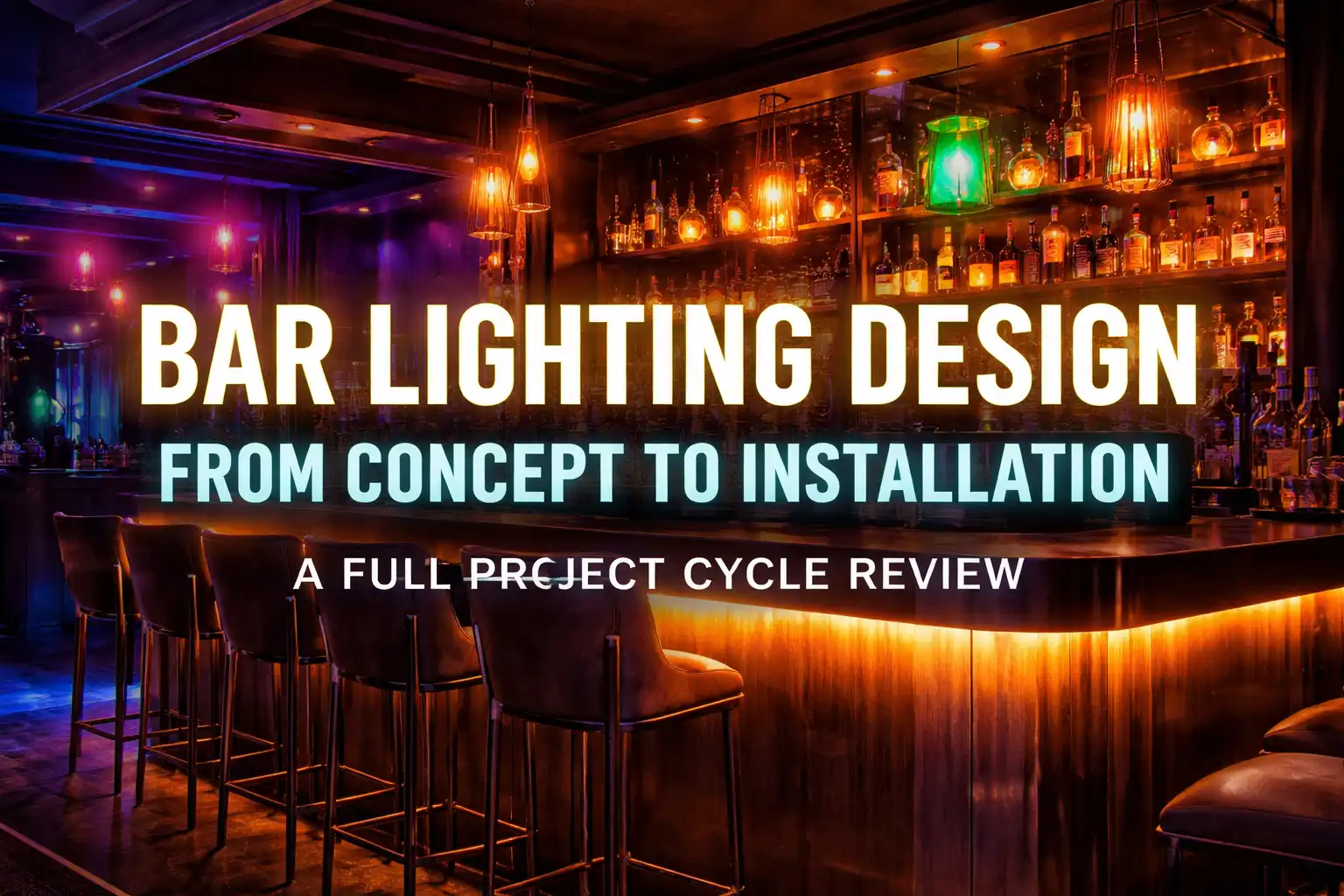
Opening a bar, the lighting system is often the element that investors underestimate the most and regret the most after opening. In 2025, our team took on a project located in a city’s old industrial district—an immersive electronic‑music bar covering 600 m² with a budget capped at 2 million RMB. The investor’s initial idea was simple: hire a lighting company to produce a few renderings, purchase the equipment, and hire a contractor to install it. This mindset is very common in the industry, but the consequences are equally common: the gap between renderings and the actual implementation, and cases where foot traffic drops 40 % from its peak within three months after opening, are not rare.
Lighting is not an accessory to interior decoration; it is the core driver of a space’s mood. A successful bar lighting system must be involved in the spatial design during the concept stage, not after the hard construction is finished. This insight only solidified after repeated trial‑and‑error during project progression.
Lighting solutions cannot be independent of traffic flow and operational logic
At the start of the project, the team performed a complete spatial modeling and traffic‑flow simulation. This is not a routine operation—most design firms would simply produce renderings—but we found that without predicting customers’ movement paths, dwell times, and consumption behaviors, lighting layouts are likely to have blind spots. For example, the bar counter area needs high‑CRI lighting (CRI > 90) to ensure the bartender’s precision, yet the main light source must not shine directly into patrons’ eyes and cause discomfort. This issue is almost impossible to capture in a rendering; it only becomes apparent when simulating light scattering from different angles in a 3‑D model.
The simulation revealed a key conflict: the investor wanted a strong visual impact at the bar counter, while the bartender required uniform, shadow‑free illumination in the work area. The solution was not compromise but zoning—install embedded linear LED strips in the bartender’s work zone and adjustable anti‑glare fixtures above the work surface; the dynamic atmosphere lighting was reserved for the front of the bar and the seating area. The two zones are controlled by independent circuits, preventing interference.
The biggest lesson at this stage is that lighting design must be synchronized with operational workflows. If designers do not know the bartender’s work path, the servers’ dish‑carrying routes, or the sight‑line relationship between the DJ booth and the dance floor, the lighting layout will inevitably have hard flaws.
From renderings to the construction site: where the discrepancy appears
When the concept was approved, we moved to construction drawings and equipment selection. There is a rarely discussed industry issue: the discrepancy between lighting renderings and reality stems mainly from construction precision and material reflectivity, not equipment performance.
Rendering software usually assumes ideal reflectance for walls, floors, and ceilings, but in practice black acoustic panels may have a reflectance of only 3 %, and dark micro‑cement floors range from 5 %–8 %. This directly causes atmosphere lighting that looks bright in renderings to be almost invisible on site. Our solution: during the construction drawing phase, we measured the actual reflectance of all finish materials and fed the data back into the lighting simulation software for a second verification. This step dramatically improved controllability of the final effect, at the cost of about one extra week of schedule. For investors eager to open, that week was a pressure, but it proved fully worthwhile.
During equipment installation, we encountered a typical pre‑fixture conflict. The truss above the dance floor originally reserved mounting spots for fixtures, but during ceiling construction it was discovered that the air‑conditioning duct occupied part of that space, preventing the four planned moving‑head fixtures from being installed simultaneously. The contractor proposed a compromise—remove one fixture and replace it with a smaller LED panel. The team rejected this because the dynamic lighting effect on the dance floor is the core experience; removing a moving head would break the symmetry and rhythm of the beams. Ultimately, the duct was partially rerouted, adding 8,000 RMB in cost but preserving the integrity of the dance‑floor lighting design.
The choice of tools at the time helped a lot. During the equipment list confirmation stage, the team used VyLen for spatial modeling of the entire lighting system and signal routing verification. The core value of this tool is not in producing renderings but in simulating signal coverage, DMX channel allocation conflicts, and power load distribution for different fixture models in the actual layout. Running it before actual wiring revealed two signal lines exceeding the stable transmission distance of the DMX512 protocol; we adjusted the positions of signal amplifiers in time, avoiding later re‑trenching.
Unexpected findings and fine‑tuning during the debugging stage
After the lighting system was installed, the debugging stage is often the most testing for a team’s patience and experience, and also the place where “surprises” occur.
During the first full‑system integration, an unexpected issue arose: when the dance‑floor strobe lights and the lobby atmosphere lights ran the preset third scene together, several spotlights in the north‑side booth area started flashing visibly. The troubleshooting process was convoluted—we ruled out power issues and dimmer faults, and finally discovered that a DMX cable running through the north wall was parallel to a high‑voltage line for about 4 m, causing electromagnetic interference.
In theory, this is simple—separating power and low‑voltage wiring is basic knowledge. In practice, electricians sometimes take shortcuts for convenience, and insufficient supervision can easily miss this. The solution was straightforward: replace the signal cable with shielded twisted pair and adjust its routing to keep at least 30 cm away from the power line. The problem was solved, but it exposed a more fundamental issue: the stability of a lighting system depends heavily on the quality of construction details, not just on equipment brands and specifications.
Another debugging discovery involved color‑temperature consistency. The same model of LED fixtures can have a 100 K–200 K temperature variance between batches. While this is invisible on a single fixture, it becomes obvious when multiple fixtures are installed side‑by‑side on a wall. After powering up all fixtures, the team performed a one‑by‑one color‑temperature calibration using a colorimeter, grouping fixtures, and readjusting driver parameters or replacing those with deviations over 150 K. This added two days of work, but after opening, customers and peers praised the space’s color consistency highly.
During the first weekend after opening, the average daily foot traffic reached about 300 people, exceeding the investor’s expectations. However, the real confidence came not from the opening day’s buzz but from the change in repeat‑purchase rate three months later. Data showed that about 65 % of returning guests cited “lighting atmosphere” as a primary reason for coming back. This is a hard‑to‑quantify metric but indirectly validates the long‑term value of a lighting system for commercial spaces.
Balancing budget and effect in renovation projects
At the same stage, the team also took on a renovation of an old factory into an immersive theater. This was a tighter‑budget, shorter‑schedule challenge. The original building had an 8‑meter ceiling height, raw cement floors, and several damaged walls. The investor wanted to transform an 800 m² space with a budget of 2–3 million RMB, including complete lighting, sound, and video systems.
The key strategy was “retain structure, reconstruct skin.” The team did not demolish the existing walls but used the factory’s industrial skeleton as the basis for lighting installation—directly fixing the truss to the original steel beams, saving the cost of a new ceiling. Lighting equipment selection was also adjusted: instead of chasing the highest lumen output or most channels, we chose mid‑range moving heads and LED strip lights with a wide color gamut and uniform mixing, combined with high‑density point décor lights to create immersion.
In the factory renovation, early spatial modeling became even more critical. Because we could not precisely predict the load‑bearing points and conduit locations of the old structure, the team again used VyLen to repeatedly simulate the feasibility of fixture installation on the existing framework, including load distribution at different positions, signal routing choices, and thermal clearance. This simulation helped avoid at least three on‑site “cannot install” embarrassments. Compared with a brand‑new build, renovation projects have more uncontrollable factors, making the fault‑tolerance value of simulation even greater.
Ultimately, the renovation project saved about 40 % of the budget, and the venue was packed for the first month after opening. The investor’s post‑mortem highlighted an interesting detail: many customers shared photos on social media where the background lighting’s color layers and spatial depth appeared even more impressive than some higher‑budget new projects. This shows that a limited budget does not mean limited effect; the key is to concentrate resources on visual focal areas rather than distributing them uniformly.
Operational feedback‑driven continuous optimization
A lighting system is not a set‑and‑forget asset after opening. Many teams end service after project delivery, but we observed that truly profitable bars adjust their lighting scenes roughly every three months to adapt to seasonal changes, event themes, or evolving customer preferences.
A concrete example: in the second month after opening, we noticed a drop in seat occupancy in the booth area after 10 pm on weekends. Historical lighting control data showed that the scene used at that time had a cool color temperature (around 6500 K), which can make people feel sleepy late at night. Adjusting the booth area’s color temperature to 3500 K–4000 K and reducing brightness by about 20 % lifted occupancy by roughly 12 percentage points over the next two weeks. This adjustment took less than an hour but had a striking effect.
Similar tweaks occurred at the DJ booth—original backlighting cast shadows on the DJ’s face, weakening visual connection with the audience. Adding a low‑angle facial fill light (matching the main atmosphere light’s color temperature) noticeably enhanced interaction, and the quality of short videos recorded by the audience improved, indirectly boosting social sharing.
These optimizations appear simple on the surface, but they rely on the flexibility and programmability built into the lighting control system. If the initial wiring did not reserve enough control loops, or the fixtures did not support independent color‑temperature and brightness adjustments, such fine‑tuning would be impossible. That is why our team insists on using programmable LED fixtures and an open‑DMX architecture during the planning stage, rather than a fixed‑scene switch system.
Lighting is not a one‑time investment; it is an iteratively evolving asset
Looking back at these two projects, the biggest takeaway is not a technical breakthrough but a pragmatic understanding of lighting’s role in commercial spaces. Many investors treat lighting as a “one‑off” pre‑opening expense, assuming that once the renderings are approved, equipment is installed, and the opening day looks good, the job is done. In reality, the true value of a lighting system lies in its ability to continuously adapt during operation—changing customer demographics, event formats, and even seasonal daylight.
A lighting system’s excellence is not judged by how flashy the renderings are, but by whether, six months after opening, a simple parameter tweak can give the space a brand‑new atmosphere. Projects that achieve this have, from the design stage, reserved ample control dimensions and redundant channels, rather than cutting wiring costs to save a few thousand yuan at the expense of scalability.
For investors planning a bar or KTV space, a reusable piece of advice is: before finalizing the lighting design, ask yourself three questions—first, can the system support at least three completely different spatial ambience switches? second, will adjusting color temperature and brightness later require re‑wiring or hardware replacement? third, does the construction team have the capability to accurately reproduce every fixture position from the design drawings on site? The answers to these questions often determine the post‑opening experience ceiling and the long‑term return on lighting investment.
FAQ
How much of the total renovation budget should be allocated to bar lighting design?
Typically 15 %–25 % of the total renovation budget, depending on the space’s positioning. Immersive bars or electronic‑music venues should aim toward the upper end; business‑style lounges can lower it slightly. Budgets below 10 % struggle to achieve dynamic atmosphere effects and later renovation costs become higher.
Which is more suitable for a bar: LED fixtures or traditional moving heads?
Both are needed in tandem. LED fixtures are ideal for basic ambience, wall washes, and color‑temperature adjustments—low power consumption and long lifespan. Traditional moving heads (beam, pattern fixtures) excel in dynamic rhythm effects on the dance floor, offering stronger beams and brightness. A single type cannot satisfy the whole space’s needs.
What control architecture is most reliable for lighting systems?
An open‑architecture DMX512 protocol is recommended for best compatibility and flexible future expansion. Wireless control is easier to install but less stable in high‑interference environments. Use wired control for the main system and wireless as a redundant backup for scene switching.
What if the lighting effect after opening doesn’t match the renderings?
First, verify that construction followed the drawings—common issues are fixture placement offsets or incorrect angles. Second, check whether actual wall and floor material reflectances match the expected values. Finally, confirm that the control system’s scene parameters align with the design files. Typically, 80 % of discrepancies stem from these three areas.
Is it necessary to have an independent lighting design for a small bar (under 200 m²)?
Yes, but the plan can be simplified. Core principles remain: zoned control, adjustable color temperature, and reserved control loops. A small space lacking lighting depth feels crowded and cheap. At minimum, configure three independent circuits (basic illumination, ambience lighting, and dynamic lighting for key areas) to cover daily operational needs.
Share Article