
AI stole my job in bar lighting design? — A lighting designer's confession

Last week I got a call from an old client, and I knew something was up the soon as the conversation started. He sent me a render and asked, “Can you finish the adjustments in half a day?” I glanced at it—36 private rooms in a KTV, each with four colored lights and three wash lights. Previously, just wiring the DMX address codes would take two days. I said it was impossible, at least three days, and I’d need an assistant.
He fell silent for three seconds, then said, “Hold on.”
I heard a few mouse clicks. Forty‑five minutes later he sent a link; the entire lighting layout for the project was already generated, complete with a timeline, scene preview, and one‑click export. I stared at the screen for a long time, my cigarette gone.
This isn’t hypothetical. It happened two months ago.
It used to take a half‑pack of cigarettes to adjust a single light, now AI does it in a minute
When I first started, lighting adjustment was physical labor. A 36‑room KTV project traditionally took about three days—wiring, writing address codes, configuring the console, then calibrating each channel’s color temperature and brightness. Every step was unavoidable. The DMX console was packed with sliders; a wrong move meant re‑cabling from scratch.
The biggest fear back then was the client standing behind you saying, “Make it brighter.” A little brighter, and the first two hours were wasted.
Later I started using smart lighting systems, which helped a lot. At least bulk address assignment no longer required manual copying. But the real game‑changer was an automated lighting sequence generator I tried last year—input the number of rooms, ceiling height, and style keywords, and it spat out a complete lighting plan. I manually tweaked it, fine‑tuning about 10 % of the brightness and color temperature before delivery.
A 36‑room KTV that used to take three days now takes less than half a day with the automated system.
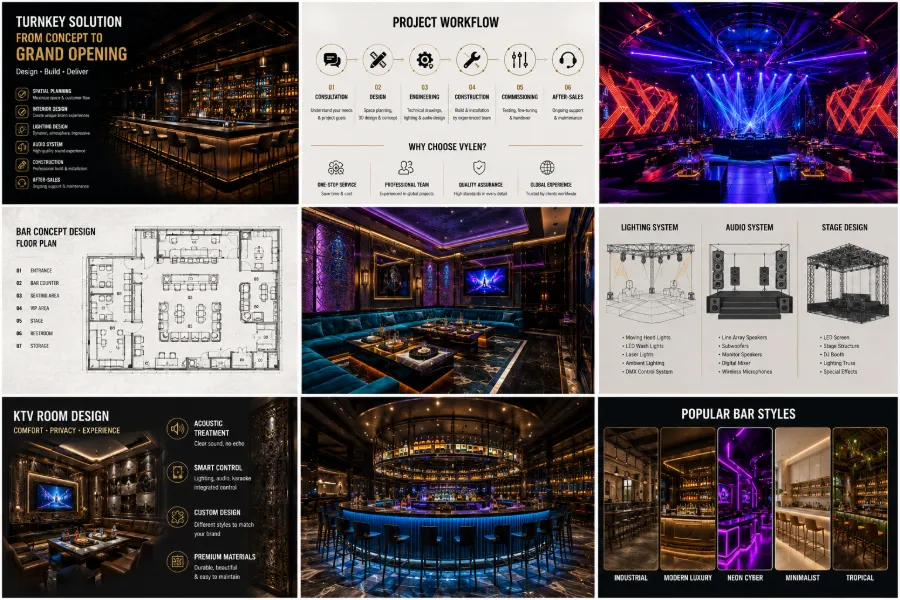
Of course, this doesn’t mean lighting designers are out of work. Automation produces “usable but not necessarily feeling” solutions. After the client receives the first version, they often say, “Add more atmosphere.” That’s where the human touch comes in. The basic labor has definitely shrunk.
If you’re choosing a lighting scheme, you can refer to my curated list of the Top 10 Most Popular Bar Lighting Layouts in 2026 (https://vylen.org/blogs/light-and-shadow-space-column-2026-most-popular-bar-lighting-layouts-top10-en). Some projects there use a combination of auto‑generation and manual fine‑tuning, and the results aren’t bad at all.
AI doesn’t just adjust lights; it can also think for you — the logic behind dynamic atmosphere generation
What really made me break a sweat was the next stage.
Last year I took on a quiet‑bar project. The client wanted a “mood progression from dinner to late night.” Previously, designers would manually create 5‑8 scenes and switch them according to the time of day. This time I tried an AI‑linked system that reacts to music rhythm—microphone picks up the live music, the algorithm analyzes BPM and frequency bands in real time, then matches a lighting scheme from an intelligent scene library.
The result was decent. During night hours, scene switching no longer required a dedicated lighting operator at the console, cutting labor costs in half. The client was happy, but I felt a subtle unease.
Those AI‑generated scenes always lacked a “human touch.” For example, when a folk singer reached the third song, the music tempo slowed down, but the AI kept using the flashing logic from the previous song—parameters were technically correct, but the live feel was off by half a beat. I ended up manually adding two scene locks so the system reverted to a fixed mode during certain periods.
There’s another controversy I still haven’t figured out: who owns the copyright of AI‑generated lighting scenes? I created a dusk atmosphere; the parameters were calculated by the system, but I tweaked the color temperature and transition duration—does that count as my work or the system’s? There’s no clear legal guidance in China, and I’ve only discussed it informally with peers.
I wrote an article on this topic: “2026 Nightclub and KTV Lighting Design Trends: From Cyberpunk to Future Minimalism” (https://vylen.org/blogs/2026-nightclub-ktv-lighting-design-trends-cyberpunk-to-future-minimalism), which covers more experiments on sound‑light interaction. If you’re unsure about tonal balance, check out the Zhihu post “Lighting Color Aesthetics in Bar Design” (https://zhuanlan.zhihu.com/p/512247669). It’s a few years old, but the color psychology insights are still reliable.
Renovating an old venue? AI gave the answer before the construction crew
In the second half of last year I was called to evaluate a renovation of an old bar. The space had been open for seven years; the wiring was a tangled mess, and the control protocol was a five‑year‑old standard that new smart fixtures couldn’t connect to. The traditional workflow was: call an electrician to troubleshoot each line, develop a demolition/renovation plan, then wait for the design institute to produce renderings—just the lighting plan took two weeks.
I tried using a 3‑D laser scan to bring the venue into a computer, then performed virtual adjustments with lighting simulation software. I could change fixture positions, angles, and simulate color temperatures directly in the model. The client said, “I want to see what warm light looks like on the window row.” I dragged a few sliders on the computer, captured a screenshot after two minutes, and sent it over. He approved and said, “Let’s do it that way.”
For the old bar renovation, the traditional process took two weeks to produce a plan; AI‑assisted preview shortened the iteration to four days.
Did AI save you money? No, it saved the client money. Because the plan was produced quickly, the client had more time to negotiate the construction budget with you. You might think AI is helping you, but it’s actually helping the client find a cheaper solution. I’ve thought about this a lot and finally accepted it—efficiency flows toward the party that pays.
But AI isn’t omnipotent — the moments when things went wrong on site
After all the good stuff, let’s talk about the crashes.
Last month I was doing system integration for an automated setup at a venue. I configured AI‑generated scenes with three time slots and five music styles. In the first test, the system set all 46 fixtures—colored lights, washes, decorative linear lights—to red. The bar was already dim; the red wash made the whole space feel like a steam sauna. It was still in soft opening, and the owner knocked on the control room door, looking very displeased.
The issue was protocol compatibility. The default color gamut mapping in the AI scene library didn’t match the actual gamut of the venue’s fixtures; the algorithm thought it was outputting amber, but it was pure red. This is a classic “scene drift”—the system isn’t broken, but the output is wrong.
I switched back to manual priority, exported three configuration files with color‑mapping tables from my laptop, and finally rescued the situation. After that I became more vigilant: before any automated system goes live, run a color‑consistency check; don’t trust the color codes in the scene library blindly.
The video above shows the correct operation of an LED wall synchronized with smart lighting—once you see it, you’ll understand how impressive the results can be. But because the system can achieve such great effects, the crash feels even more dramatic. That day the system went from ideal to opposite.
If you’re considering automated lighting, start with the article “Five Common Techniques in Bar Lighting Design” (https://www.sohu.com/a/230866370_504861), which covers basic methods. Automation is fast, but crashes are costly—especially for subcontractors.
After that crash, the client began doubting the reliability of automation. I spent two evenings manually re‑writing the curve for each scene, then told him, “The system works, but you need someone watching it.” He asked what we could do. I sent him a link to VYLEN (https://vylen.org) because their smart lighting system has relatively clean compatibility and frequently updated mapping tables across brands, which at least reduces low‑level color‑drift crashes.
In reality, AI’s mistakes are rarely “wrong”; they’re “too right for the wrong context.” It doesn’t know the difference between a quiet bar and a nightclub; it only knows the parameters are correct. That underscores the importance of the “context‑judgment” experience that still can’t be replaced.
So what has AI actually changed? — a lighting designer’s frank take
After years in lighting, my conclusion is simple: AI isn’t here to replace designers; it’s here to replace the “scene‑number‑only” lighting technicians.
In the past, 90 % of a lighting job was repetitive work—checking addresses, assigning addresses, changing addresses. Those are tasks humans don’t need to do. AI takes them away, leaving narrative space, atmosphere, and client communication—the truly valuable parts.
Another interesting phenomenon: clients usually love the first AI‑generated proposal because it’s clean, symmetrical, and parameter‑correct. The designer’s job is precisely to subtract from that first version or add a “misplacement”—for example, intentionally leaving a row of lights off on a wall to create negative space. That intuition isn’t something algorithms have learned yet.
The industry is shifting from “can adjust lights” to “can use AI to adjust lights.” At the end of last year I pulled out my manual adjustment workflow documentation and deleted 70 % of the steps—those are now automated. The remaining 30 % are about judging when a space should feel cool or warm.
Working together with AI is far more valuable than being replaced by it.
Frequently Asked Questions
Can AI lighting design completely replace humans?
Not yet. AI excels at parameter‑level batch addressing and scene generation, but it lacks the ability to judge spatial atmosphere—especially the contextual differences between a quiet bar and a nightclub. Automation can cut repetitive labor by more than 50 %, but final scene fine‑tuning and on‑the‑fly adjustments still require a human.
Can old venues still be renovated with automated systems?
Yes. The core issues in old venues are protocol compatibility and outdated wiring. AI‑assisted previews can simulate renovation effects with 3‑D modeling before any demolition, helping decide the renovation plan. However, automation isn’t a universal glue; color‑gamut mapping between different brands must be verified separately to avoid color drift.
Are low‑budget KTVs suitable for AI lighting?
Yes. Low‑budget projects often lack a dedicated designer; AI can replace part of a junior lighting technician’s work. It’s still advisable to keep at least one manual‑override switch—when things go wrong, you’ll thank yourself.
Share Article