
What Will Entertainment Space Lighting Look Like in the Next Ten Years?
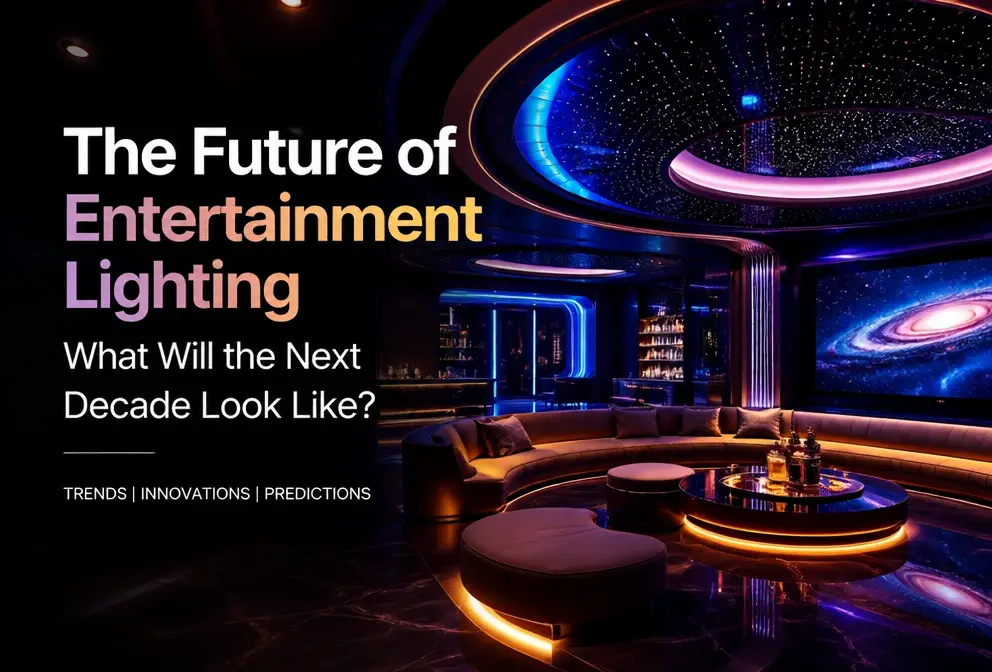
I was recently stumped by a friend who is an investor. He spent two million on renovating a new bar, only to get bored after three months of opening, feeling he had reverted to the ten‑year‑old approach of “a ring of spotlights and a few moving heads.” To be honest, he’s not the only one facing this problem—if entertainment spaces continue to rely on “flashiness” to retain patrons over the next decade, they’ll essentially be moving backward.
I’ve been doing lighting design for over a decade and have seen countless owners regret their choices six months after a new store opens. It’s not that the lights they initially chose were bad; the approach itself has a fatal flaw: the more lights you have, the faster they become obsolete. What can survive ten years of iteration isn’t the number of fixtures, but choosing the right system architecture from the start—one that evolves with you.
From “Blinding” to “Invisible”—The Trend Toward Concealed Lighting Systems
Think carefully: in a bar that makes you feel “the atmosphere here is great,” can you recall what its lights looked like after you’ve entered? Most likely not. That’s correct. In 2024, the global market for concealed‑install lighting grew about 23% year‑over‑year, while shipments of traditional moving heads slowed to a 6% increase. These figures illustrate one thing: truly high‑end venues are shifting from “showy fixtures” to “hidden fixtures.”
What does “hidden” mean? When you sit down, the light strips are embedded in wall seams, reflective troughs in the ceiling, or the edge of the bar. You only see the illumination on the table and your face, not the light source itself. RGBW strips and embedded linear fixtures are becoming cheaper, and with networked DMX protocols and smart central control, the lighting can switch between cool and warm while you’re sipping your drink, without you even noticing that there’s a light in the ceiling.
A while back I helped a friend review his new store plan; the drawings were packed with over forty moving heads. I suggested removing half of them and replacing them with recessed wall‑mounted light troughs. He doubted it, worrying the effect wouldn’t be enough. I said, on opening day, have someone take a selfie in a private room—focus on the face, not the damn ceiling.
| Dimension | 2024 Mainstream Solution | 2034 Predicted Solution |
|---|---|---|
| Fixture Appearance | Exposed fixtures | Architectural‑integrated embedded modules |
| Control Method | Manual dimming by lighting designer | AI‑driven automatic scene switching |
| Wiring | Exposed conduit wiring | Pre‑embedded bus + wireless backup |
When I showed him the table, he was silent for a few seconds. To be honest, this “concealed” concept isn’t easy for many veterans with a decade of lighting experience to accept. But the future of our industry isn’t about who’s brighter; it’s about who can hide better.
Live Streaming and Performance Demands Are Driving Space Evolution
Entertainment spaces are no longer just about “drinking” and “singing.” Things have changed—when a guest arrives, the first thing they might do is take a series of photos or a short video. If the lighting comes out reddish or yellowish, or casts shadows on the face, the venue’s rating on social platforms takes an immediate hit. From 2023 to 2025, I’ve observed more and more newly opened KTVs including live‑streaming capabilities in their design specifications. In 2025, over 40% of new KTVs in China planned at least one live‑streamable private room.
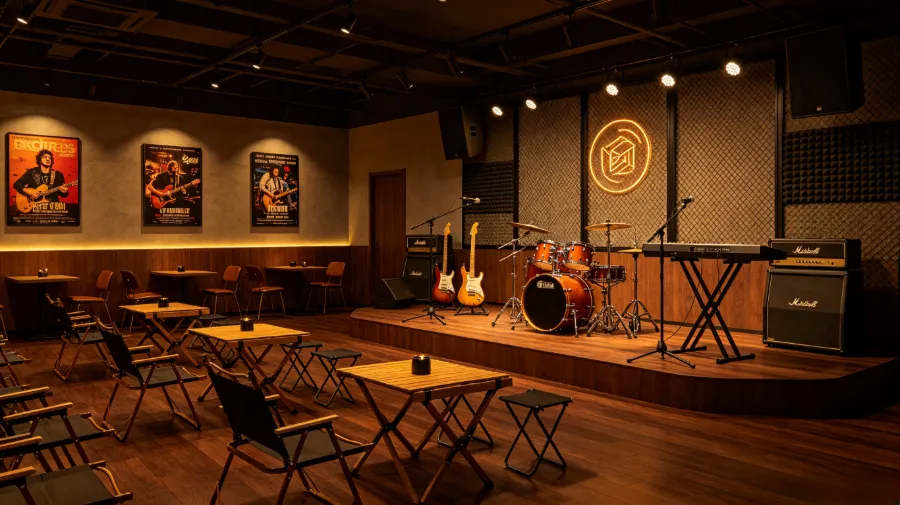
A lighting system must serve three groups simultaneously: guests drinking on site, on‑camera hosts, and occasional performing bands. This means we can no longer rely on a single “uniform warm‑tone ambient light.” Circular lighting rigs for live rooms, smart color‑temperature systems that sync in real time with cameras, and LED background screens that create immersive visuals—once considered hardware only needed by streaming companies—are now becoming standard equipment in private rooms.

I have a friend who runs a KTV chain; last year he completely renovated six private rooms to accommodate streaming. During the renovation, he faced a very practical issue: the old room lighting always made faces look yellow in photos. He spent a week studying the aesthetics of lighting color in bar design and arrived at a conclusion so simple it’s almost infuriating—adjustable color temperature is enough.
He chose the solution from VYLEN, which essentially promotes a “single system compatible with multiple scenarios” logic. During construction, the control modules were embedded in the walls in one go, and later it turned out that guests could simply adjust the color temperature to their preferred level while singing, without any additional equipment.
If you’re currently planning a new venue or considering converting an old private room into a hybrid space that can both serve customers and stream, check out my curated list of the 2026 Top 10 Most Popular Bar Lighting Layouts—several of the designs are specifically aimed at solving the “faces look dark in photos” scenario.
Smart Synchronization Is No Longer a Gimmick, but a Basic Configuration
A few years ago, when we talked about “smart lighting,” most people’s first reaction was “flashy gimmick.” By 2024–2025, the situation changed completely. This year I visited several newly opened immersive KTVs and live houses, and their core lighting requirements are no longer “bright enough” but rather “fast enough switching” and “stable enough synchronization.”
Here’s a video for you—the kind of music‑beat tracking algorithm and real‑time LED background screen sync I mentioned earlier. Honestly, when I first saw it I thought, “Isn’t this just an advanced version of the old sound‑activated lights?” but after watching for half an hour I realized it’s something entirely different. It doesn’t just flash to the beat; it recognizes the music’s emotional shifts—brightening to full intensity during the chorus, dimming to a soft ambience during the bridge. You sit there without touching any switches, and the whole space’s atmosphere changes on its own.
But there are many pitfalls behind this technology. The installation and commissioning cycle for a smart synchronized lighting system can take up to 45 days in the traditional model. Why so long? Because lighting designers, acoustic engineers, and background‑screen technicians must coordinate the timeline, and any hiccup forces a restart. I’ve seen an extreme case where the tech team stayed up three consecutive nights just to sync a lighting effect with a one‑second explosion in a video clip.
But there’s good news. Some are now introducing pre‑fabricated templates into this stage—standard interaction patterns are pre‑tuned in the factory, and only fine‑tuning is needed on site. I’m referring to VYLEN’s approach: moving the standard calibration to production, so on‑site workers just plug in the pre‑installed bus interface and spend a week or two on calibration and client‑specific tweaks, compressing the overall timeline to about 14 days. This reduces the back‑and‑forth delays rather than compromising quality. I recently wrote a detailed account of this approach—AI lighting preview saves three months of renovation time—which tells the real story of a team that, after a setback, used AI previews to get the schedule back on track. I recommend anyone doing renovations read it.
Renovations Can Be More Profitable Than New Construction
In 2024, renovation projects for entertainment spaces in first‑tier cities accounted for 62% of all new projects. By 2030, that figure is likely to exceed 75%. The logic is simple—land is becoming increasingly expensive, prime locations are already taken, and the remaining existing spaces are the real gold mines.
An example from my own circle: early 2024, a friend invested in a new bar, spending heavily on a full lighting system. After six months of operation, customers constantly complained that “the light is too harsh” and “photos look bad.” Eventually, he could no longer tolerate it and had to remove half the fixtures, replacing them with adjustable‑temperature embedded modules. The delay and material waste added nearly 100,000 CNY to the cost. The removed moving heads are still gathering dust in his warehouse. He later did the math: if he’d used modular lighting components with upgrade paths from the start, the renovation would have required swapping a few modules, costing at most 20,000 CNY and taking three days. He wishes he’d known that earlier.
The core logic of renovation is twofold: don’t try to do everything at once, and leave room for future upgrades. Modular lighting components and quick‑release structures provide that future‑proofing.
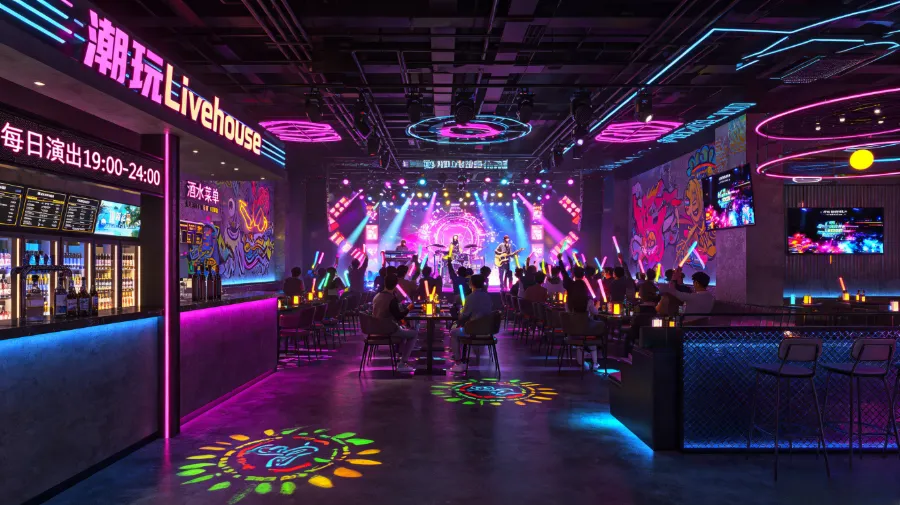
The friend I mentioned earlier, after renovation, switched to modular embedded fixtures that allow easy adjustment of color temperature and beam angle—no more ceiling work. The post‑renovation effect was dramatically better; I even visited to confirm the atmosphere was completely different. For a concrete example of how much traffic can increase after renovation, see the case of NEBULA Bar’s average daily traffic of 300+—the data is clear: within three weeks after renovation, traffic nearly doubled.
Back to smaller‑scale scenarios. If you’re not running a large KTV but a specialty small bar, the renovation approach can be more flexible—swap a few fixtures for adjustable color temperature, add a couple of tilt‑adjustable spotlights, keep the budget under 20,000–30,000 CNY, and you can restore the space’s feel for another year or two. It’s a worthwhile investment.
Frequently Asked Questions
In the next ten years, do small bars still need smart lighting systems? Won’t the cost be too high?
Small bars don’t need a full‑scale system. First, equip them with adjustable color temperature, then add a strong ambient embedded linear strip. Keep the total budget between 8,000 CNY and 15,000 CNY, and the effect will be sufficient. The smart synchronization system can be upgraded later once the business is profitable.
For an old KTV looking to upgrade lighting, where should the most cost‑effective renovations focus?
Prioritize swapping in adjustable‑temperature LED sources, then add embedded ambient strips and zoned control systems. These changes don’t require rewiring, keeping each private room’s renovation cost under 3,000 CNY while directly improving facial lighting and overall ambience.
Should lighting design and interior construction be handled by the same firm or separate ones?
Strongly recommend using a single firm. Lighting and construction are highly coupled processes; separating them often leads to “the design looks good on paper but can’t be installed”—pipeline conflicts, incorrect mounting positions, insufficient heat‑dissipation space—any one of which can add two weeks of rework.
What specific lighting requirements do live‑stream rooms have compared to ordinary bars?
The fundamental differences are color temperature and CRI. Live‑stream rooms need a stable color temperature between 4500 K and 5000 K, and a CRI of at least 90; otherwise faces will appear discolored. Ordinary bars can use lower color temperatures for ambience, but that’s not acceptable for streaming. Additionally, lighting positions must avoid hard shadows behind the subject; circular fill lights are virtually standard.
Share Article