
NEBULA Bar Daily Average Footfall 300+: A Real‑World Case of a Light‑Shadow Matrix
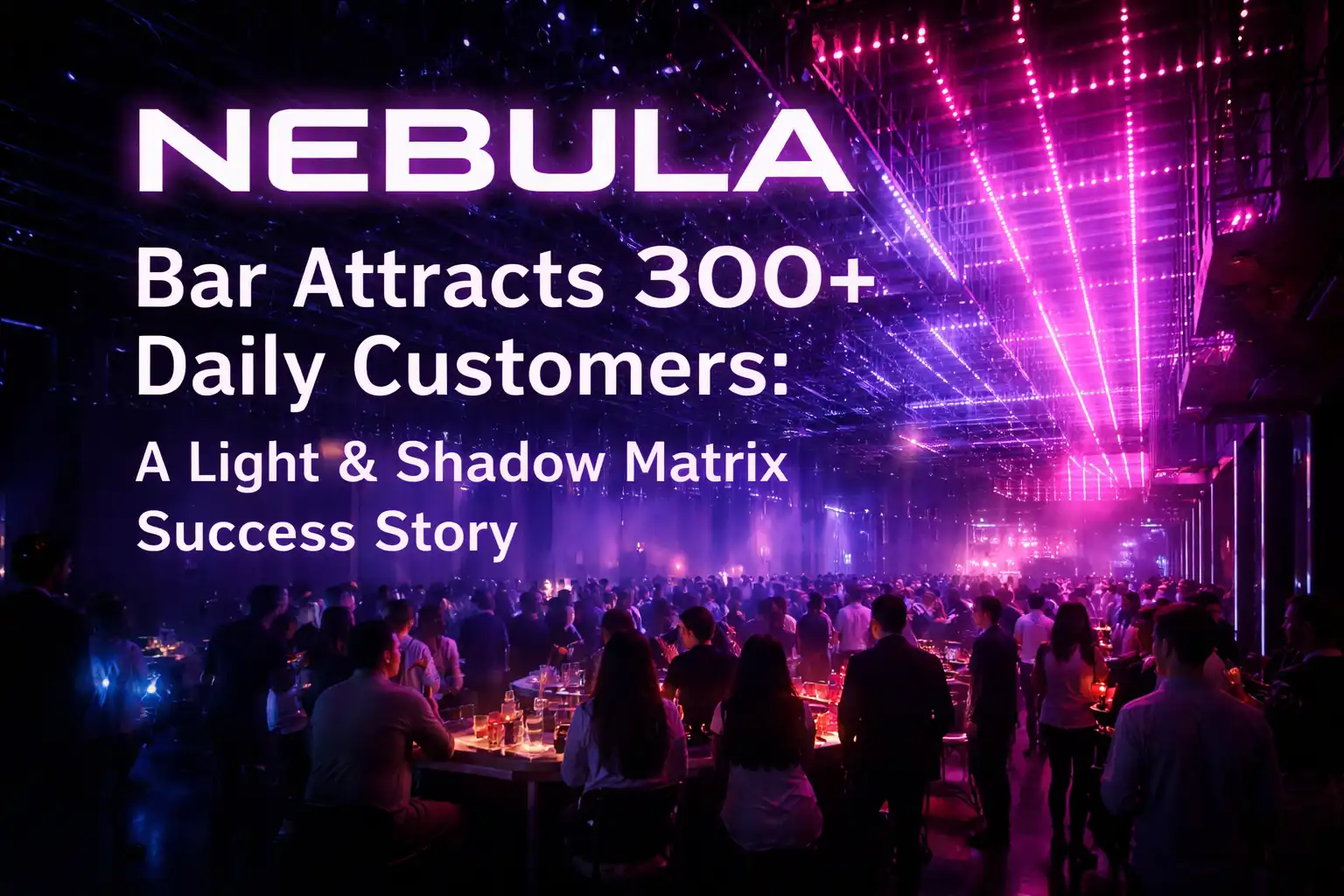
In the summer of 2025, a bar called NEBULA opened in Nanshan District, Shenzhen. One month before opening, the team expected an average of 150 guests per day, just enough to cover rent and labor. The first weekend already attracted over 400 people, and by the third week the daily average stabilized above 300. The location wasn’t especially prime—the building had previously housed a failed restaurant that changed hands three times without surviving six months. There was no secret cocktail formula either—those few signature drinks on the menu could be made by eight out of ten bars in Shenzhen.
What truly set NEBULA apart was the space itself after you walked in. An immersive environment built with a light‑shadow matrix, where lighting, sound, and spatial flow were choreographed as a single whole. Entering was not just stepping into a bar, but into a deliberately designed scene. The core of this system was an intelligent lighting coordination solution, handled end‑to‑end by the designers—from spatial modeling and fixture selection to final programming and debugging, which took almost three months.
This article breaks down that case—not to boast about its success, but to discuss the details that truly determine success or failure: how the venue was evaluated, how the lighting system was proportioned, what pitfalls were encountered during construction, and how operations kept the traffic after opening. If you are considering a similar commercial space renovation or have a project in the implementation stage, some of these insights may be directly applicable.
Key Judgments in Venue Evaluation and Space Renovation
NEBULA’s original site was an old dining space with a ceiling height of 5.2 m and an area of about 420 m². This height is above average for bars, but the original building had several hard flaws: unevenly distributed columns, a large beam in the southeast corner that split the space into two sections, and poor acoustic reflection. The previous restaurant used acoustic panels for sound absorption, but for lighting this wall treatment weakens diffuse reflection, reducing visual depth.
The designers’ first step was not to produce renderings, but to do two things: on‑site light measurement and façade utilization calculation. Light measurement used a lux meter to record the angle and intensity of natural light at different times of day—because NEBULA also hosts afternoon business‑social sessions, daytime lighting needed control. Facade utilization was calculated by pricing each wall’s “visual touch points” per unit area: which walls were suitable for primary visuals, which could only host auxiliary light strips, and which were best left for projection. This logic later directly influenced fixture selection and layout. The final implementation kept the southeast beam and turned it into a floating light column, turning the most troublesome structural defect into a visual focal point.
This stage of judgment largely avoided a common mistake—many bars first divide the space into zones and then match lighting, resulting in clashes between light and structure that require extra fixtures to compensate for dark spots. NEBULA’s approach was the opposite: define the lighting logic first, then set the spatial boundaries.
Lighting System Configuration Logic—Brighter Isn’t Always Better
People who have visited NEBULA on‑site usually comment first, “How is the brightness controlled?” It doesn’t rely on darkness to create atmosphere like traditional bars, nor does it sweep the room with high‑intensity LED strips like many trendy spots. Its base illuminance is roughly 80–120 lux—a measured value that is 30 % higher than a typical bar, yet the eye does not perceive it as “bright” because the color temperature and directionality are layered.
The space is divided into four lighting layers: the top layer uses RGBW wash lights and beam lights for ambiance and rhythm changes; the middle layer consists of downlights and track spotlights for functional tabletop illumination, fixed at 3000 K; the bottom layer uses recessed floor lights and side light strips to guide movement; the dynamic layer includes programmable moving‑head lights and laser groups that sync with music for scene transitions.
One easily overlooked issue is fixture quality control. NEBULA initially tested a batch of common market DMX controllers and, after two weeks, discovered a fatal problem—color batch consistency. Fixtures from the same batch, set to the same blue, showed a 3–5 % color deviation to the naked eye; during rapid scene changes this discrepancy became amplified, making the whole space look “dirty.” The final selection fell on the VYLEN solution, not because its LEDs were the brightest, but because its color temperature consistency remained stable under both visual and instrument testing, and its control system supported one‑click multi‑scene switching—from afternoon mode to nighttime party mode with a single preset, no re‑tuning required. This “one‑click switch” became a high‑frequency feature in actual operation: at least twenty switches per day, operable by staff without a dedicated lighting technician.
The Near‑Disaster Opening Week
Three days before opening, the team decided: because there wasn’t enough time for full equipment debugging, they would first launch a “simplified” lighting scheme and upgrade later. On opening night, the simplified scene transition lagged more than three seconds—by the time the music reached the chorus, the lights were still transitioning, causing the atmosphere to break several times. That night’s average spend was only 60 % of the target, and backend data showed almost zero repeat bookings the next day.
The problem lay in the signal path. The lighting control system used the ART‑Net protocol over a switch, but the switch selected was a regular 100 Mbps desktop model, which dropped packets under load. At 2 a.m. the next day, the team did two things: first, replaced the switch with a gigabit industrial‑grade unit; second, ran a dedicated lighting network cable completely isolated from the regular network. This change cost only a few hundred dollars but produced immediate results—by the third day, scene transition latency dropped to under 0.3 seconds, essentially imperceptible.
This incident became an internal lesson: lighting is no longer a “post‑construction accessory”; it is a real‑time operating system. Any intermediate link—switch, cable, controller firmware—can become a bottleneck. If you only perform a “lights‑on test” before opening without stress‑testing scene transitions, a failure is inevitable.
Operational Implementation: Keeping the Traffic Once It Arrives
A daily average of 300+ guests does not happen automatically from a design plan. In the second week after opening, the team noticed an odd pattern: Friday night peak traffic occurred between 21:00–22:00, but after 23:00 it dropped quickly, failing to retain guests. Investigation revealed the issue was the lighting timeline—after 23:00 the scene preset remained the same as at 21:00, offering no “late‑night” visual cue, so customers felt the atmosphere hadn’t changed and left.
The solution was straightforward: add a new timeline preset. From 21:00–22:00 the lighting is warm and low‑dynamic; from 22:00–23:30 it switches to higher color temperature and higher dynamics, matching faster music; after 23:30 it returns to a soft but not dark purple‑blue tone, intended to relax people without prompting them to leave. This timeline was programmed into the VYLEN control system and runs automatically daily without manual intervention. After the adjustment, the post‑23:00 retention rate rose from 42 % to 71 %.
Another operational detail links drink pricing to lighting. NEBULA’s cocktail packages are priced 15–20 % higher than nearby competitors, yet complaint rates are lower. The reason is simple: the lighting turns each table into a “semi‑private” social unit—each table’s illumination is precisely confined to a 1.5 m diameter, with minimal light spill onto neighboring tables. Guests feel they have privacy, making them more willing to spend and to post photos on social media. Social platform exposure grew nearly 400 % in the first month, essentially at zero advertising cost.
FAQ
Is the lighting solution for NEBULA Bar expensive?
Based on publicly available industry data, NEBULA’s lighting investment was roughly 350,000–450,000 CNY, accounting for 20–25 % of the total renovation budget. This proportion is mid‑to‑high for high‑end bars, but when factoring in saved labor costs and increased conversion rates, the payback period is about 8–10 months.
Can simply installing an intelligent lighting system increase foot traffic?
No. The lighting system itself is just a tool; the real impact comes from the combination of scene choreography and operational rhythm. NEBULA’s success wasn’t because it installed a good set of lights, but because it integrated lighting with timelines, music, and beverage strategy into a cohesive package. Buying hardware alone is useless; someone must spend time calibrating, testing, and adjusting based on data.
Are small bars suitable for immersive light‑shadow experiences?
It depends on floor area and ceiling height. If the area is under 200 m² or the ceiling is lower than 3 m, an immersive solution’s effect diminishes dramatically, making the ROI unattractive. In such cases, it’s advisable to prioritize functional lighting with a modest amount of ambiance lighting, allocating budget to flow design and acoustic treatment rather than overloading on fixtures.
Is maintaining the lighting system cumbersome?
Daily maintenance mainly depends on the mix of fixture types. In NEBULA’s setup, conventional light sources (downlights, track lights, recessed floor lights) have lifespans exceeding 30,000 hours and typically require no intervention within two years. Dynamic fixtures (moving‑head lights, lasers) need maintenance every 6–12 months, mainly lens cleaning and fan replacement. Firmware updates for the control system occur quarterly and are performed remotely by the designers, requiring no on‑site work.
Share Article