
Opening a Bar/KTV: Do Those “Complete Solutions” Really Work?

When I opened my first bar, my understanding of “complete solutions” was naïve. I negotiated wall and floor work with the renovation crew, agreed on the number and placement of fixtures with the lighting supplier, and hired an audio technician to run speaker cables—I thought each of these three groups would do their part and the shop would just come together. On opening night, the lighting and music each ran their own show: the bar counter was as bright as an operating room while the booth area was so dim that guests couldn’t see the glasses on their own tables. A friend standing at the door looked and said, “Who installed those lights? I can read the bartender’s expression crystal‑clear, and the guests in the corner probably can’t even see the drink menu.” It wasn’t until I later worked with a company that actually delivers full‑scale projects that I realized each of the four words in “complete solution” hides its own pitfalls.
Design Is Not Just a Few Renderings, It’s a Set of Buildable Construction Drawings
Many full‑service firms love to show you gorgeous renderings—colorful lighting, cool geometric shapes, a booth area that oozes atmosphere. But you have to ask: does this rendering come with a lighting layout plan? An acoustic design? CAD drawings that coordinate HVAC and fire‑suppression piping?
I’ve seen a project where the design firm produced more than twenty renderings, the client approved them, and construction began. When the electricians arrived, they discovered that the lighting circuits were tangled with the central air ducts, and two main lighting lines ran directly under fire‑sprinkler heads. Fixing it added twelve days to the schedule. The renovation materials had already been delivered, and returning them incurred freight costs. This isn’t an isolated case—industry statistics show that over 40 % of renovation projects require rework because lighting/electrical routes clash with spatial changes.
A true full‑service firm will deliver a complete set of construction drawings alongside the renderings, including DMX address assignments for each lamp, transformer locations for each strip light, and mounting heights for every dimming module. These drawings are for the construction crew, not the client. If the solution you receive only contains renderings and no construction drawings, your renovation is almost certainly going to need a redo. For a practical case study on lighting previews, see this article on How AI lighting preview saves three months of renovation time and brings new hassles, which discusses the gap between renderings and actual tuning.
Lighting System: Atmosphere Is Not Mystical, It’s Calculated
Many people think a lighting system is just a few wires, a handful of spotlights, and a couple of color‑changing bulbs. A friend spent ¥600,000 on KTV lighting, buying everything as loose parts—RGB downlights from an online marketplace, “flower” floodlights recommended by a friend, and a DIY controller. On the night before opening, they discovered that the two types of lights used incompatible DMX protocols: the downlights responded to the central controller, while the flower lights did nothing. He spent the evening making over thirty phone calls and finally found a supplier who could deliver a compatible controller overnight, at an extra ¥80,000, to get all the lights working.
That lesson taught me that lighting atmosphere isn’t about stacking more fixtures; it’s about calculation. You must calculate load power, controller channel count, dimming curve smoothness, and brightness‑color temperature combinations for different scenes.
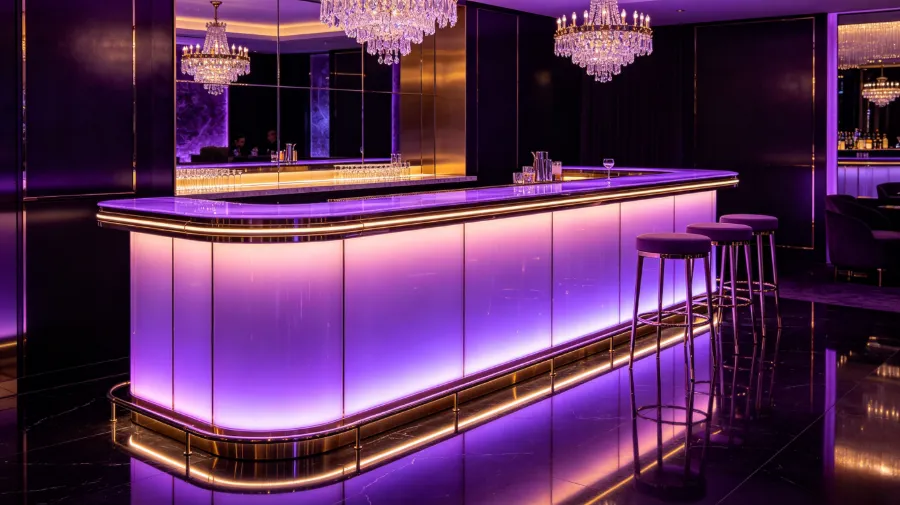
That’s why, when I later encountered VYLEN, my first question was: “If your lighting system loses power and restarts, will the pre‑set scenes drift?” They showed me their intelligent central control solution—DMX protocol unified, all fixtures on a single control bus, with preset “high‑energy,” “chat,” “birthday queue,” and “late‑night wrap‑up” modes that switch with one click. The difference between this and a DIY patchwork is like taking a photo with an iPhone versus assembling a custom digital camera—one delivers consistent results, the other surprises you every time, and not in a good way. For concrete creative lighting layout ideas, check out this article on 13 Creative Bar Lighting Ideas to Elevate Your Space, which offers many adaptable pairing schemes.
Sing Enjoy KTV flagship store equipped all 36 private rooms with an intelligent lighting linkage system, and the room‑re‑booking rate rose by 40 %. I didn’t believe that number at first, but after sitting for half an hour I understood—when guests sit down to sing, the lights subtly follow the music’s rhythm, the main lights dim automatically at the chorus climax, and spotlights hit the screen’s sides. It’s a far richer experience than simply leaving the overhead lights on.
Execution on Site: Nice Renderings Don’t Mean Workers Can Replicate Them
No matter how beautiful the design drawings are, the real test is on the construction site. My biggest pitfall was a geometric glowing ceiling that looked layered and modern in the rendering. When construction began, the steel specifications annotated on the drawings were unavailable locally; ordering them required a 15 % price increase and a two‑week lead time. The workers suggested “use a close‑enough size,” and the project manager said “a one‑centimeter difference won’t be noticeable.” After installation, the proportions were completely off; I stared at it for three days before finally tearing it down and starting over.
The hidden value of a “complete solution” isn’t convenience—it’s having a single point of responsibility when problems arise. If the design drawing is wrong, the full‑service firm fixes it; if material specs are off, they replace them; if on‑site dimensions don’t match the drawings, they adjust on the spot. No back‑and‑forth between three separate companies, no “the designer says yes, the contractor says no.” For real‑world case studies, see this article sharing many authentic Award‑Winning Bar Lighting Design Stories: Debugging, Rework, and Unsolved Mysteries. The mishaps described made me laugh—only to realize I’d experienced similar ones myself.
Standardized processes bring controllability: experienced full‑service firms conduct on‑site inspections and milestone acceptances, with material lists and acceptance criteria at each stage. Industry averages show that standardized processes can cut schedule time by 30 % and reduce rework by 50 %, provided the team truly understands construction, not just drawing.
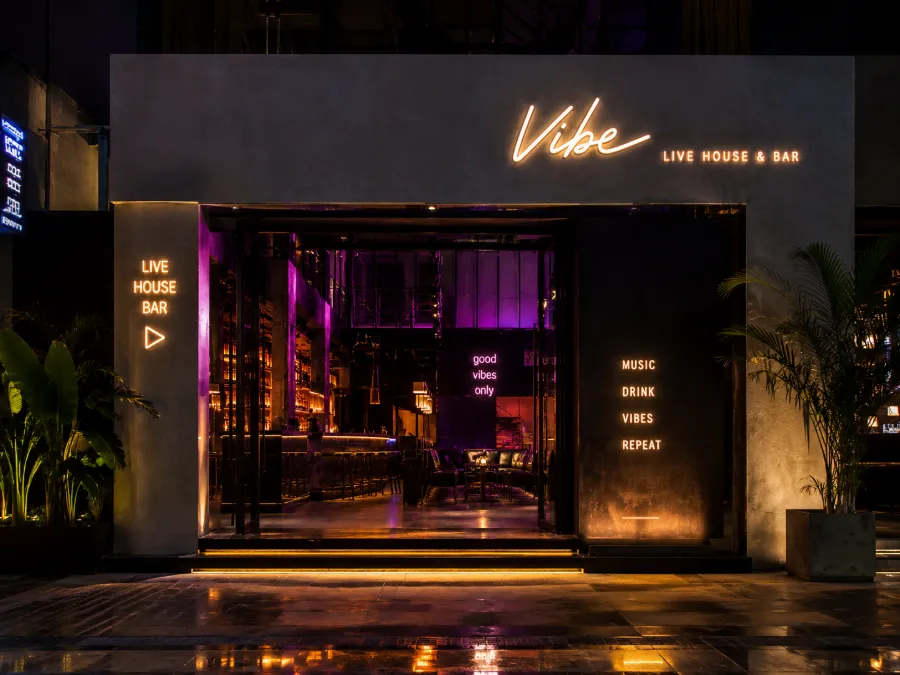
Opening Is Not the End; Ongoing Operations Are the Real Delivery
I’ve seen many shops packed with crowds the opening weekend, only to go quiet the next week. The reason is simple—opening planning and equipment tuning were completed, but then no one managed the venue. Lighting scenes drifted after a short period, audio settings were unintentionally changed and never restored, and staff training was insufficient, causing mismatched lighting and music.
A complete solution should cover the post‑opening operational phase. After equipment tuning, someone must train the manager’s maintenance team on the central control system; during the first month, on‑site support should monitor details. CLUB NEBULA’s opening day topped local popularity charts, with an average daily footfall of over 300 guests. That success wasn’t just due to great lighting—it was also the result of pre‑opening marketing rhythm, equipment tuning, and staff training all being run through in advance.
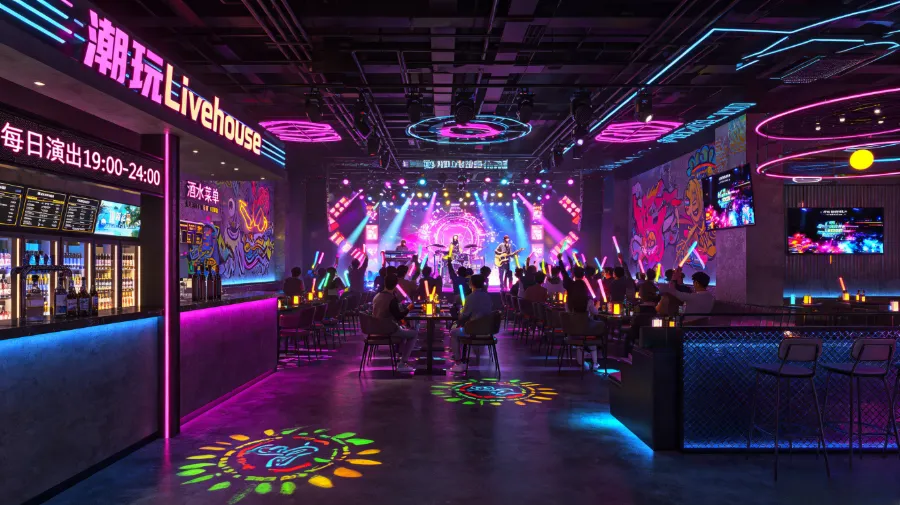
VYLEN’s business model has an interesting twist—its profit is tied to the client’s operational performance. If the shop does well, they keep the partnership; if it does poorly, they share the loss. This forces them to consider operational efficiency during the design phase rather than merely chasing visual impact. For future spatial trends, see this overview of 2026 Nightclub & KTV Lighting Design Trends: From Cyberpunk to Future Minimalism, which discusses lighting approaches that look great without creating operational headaches. If you’re serious about bar space design, check out this article on Bar Design Proposals: Engaging the Senses & Rendering Atmosphere to help you assess whether a full‑service firm truly thinks about operations.
FAQ
What service phases are included in a complete entertainment‑venue solution?
Typically five phases: requirement communication & positioning analysis, concept方案 & rendering design, construction drawings & lighting system design, on‑site construction & milestone acceptance, and opening‑day tuning & operational support. The fifth phase is often omitted, yet it directly affects the venue’s stability in the first three months.
Why not hire separate design and construction teams?
The biggest issue is who takes responsibility when something goes wrong. Designers say “the contractor misunderstood,” contractors say “the design is impractical,” and you’re stuck mediating. A single full‑service firm handles drawing revisions, on‑site adjustments, and saves communication costs that usually outweigh any price difference from “separate outsourcing.”
Must a lighting system use intelligent central control?
It depends on scale. For three to five spotlights with no multi‑scene switching, manual switches suffice. Anything with more than twelve circuits or requiring timed ambiance changes essentially needs smart central control. Without it, every scene change requires someone to walk to the electrical panel and flip switches, which looks unprofessional to guests.
Can I still call the original company after opening if problems arise?
That depends on whether your contract includes an operation period. Most firms leave after the pre‑opening tuning. It’s advisable to negotiate a month of on‑site operational support and two quarters of remote tuning support in the contract; it’s far more cost‑effective than finding someone later.
Is a full‑service firm suitable for a small bar with a limited budget?
Yes, but choose the right collaboration model. Small projects mainly need lighting layout and construction execution, not complex smart systems. A full‑service firm can save you hidden costs like “ill‑designed lighting circuits requiring later retrofits.” If the budget is tight, you can ask the firm to handle only the critical zones with custom design while using standardized solutions for the rest.
Share Article