
Do I really need to hire a professional lighting designer?
You’ve opened a bar or KTV, finished the hard construction, placed the sofas, and now the final step—lighting (see Three years after renovating an old bar: experience). You stand in the empty venue, look at the few exposed wiring lines on the ceiling, and a soul‑searching question pops up: “Can I just buy a few spotlights myself and screw them up? Do I really have to spend a lot of money to hire a professional lighting designer?” I thought the same back then, and then… I learned a lesson and saw something clearly.
In short, a lighting designer doesn’t earn money from “tuning lights” but from “preventing you from redoing work”. You can return a wrong piece of equipment, but you can’t get back lost time. It took me three months of renovation and nearly ¥40,000 in cash flow to truly understand this.
Don’t rush to order—these three scenarios are fine to DIY
I’ve done it myself. In 2021 I installed lighting for a friend’s home game room, bought six Philips Hue color bulbs, connected them to Wi‑Fi, and a single phone color change gave a surprisingly good effect (27 lighting ideas). The room was under 15 m², no commercial pressure, lighting was just for fun—nobody would leave a bad review for unprofessional lighting. In that context, DIY was perfectly fine.
When can you DIY? I’ve summarized a few boundaries:
| Lighting need scenario | Suggested solution | Estimated cost | Failure risk |
|---|---|---|---|
| Home game room / balcony | Smart bulbs self‑connected | ¥800‑¥1500 | Low |
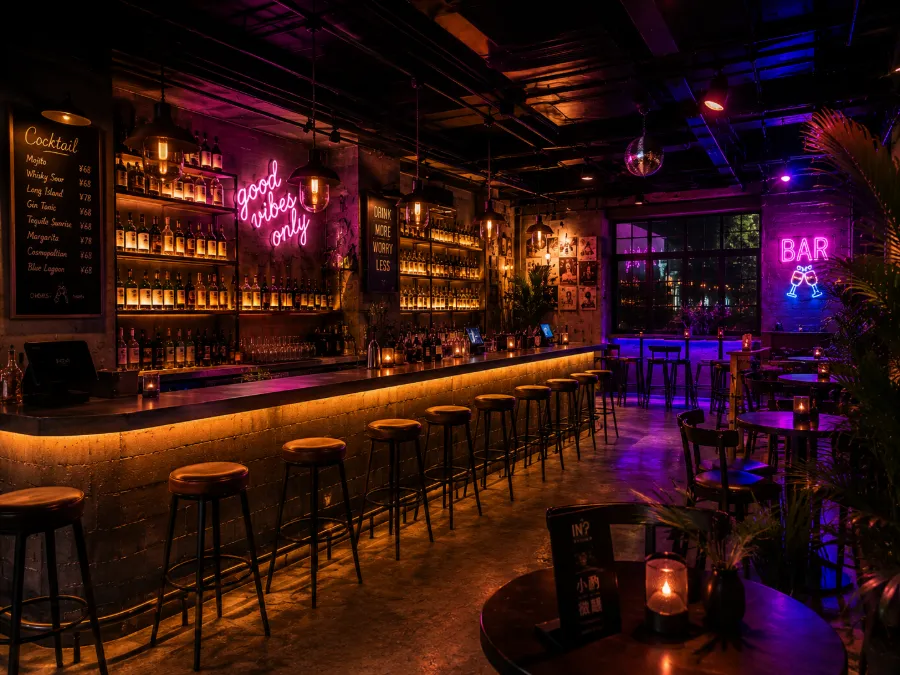
| Small bar (≤10 tables, off‑peak) | Smart LED strip + spotlights combo | ¥2000‑¥5000 | Medium |
| Commercial bar/KTV/nightclub | Professional lighting system | ¥10,000‑¥100,000+ | Very high |
The threshold is clear: if your lighting doesn’t directly affect revenue—no guest attraction, no upselling, no content creation—DIY is enough. An entry‑level set of six smart bulbs costs about ¥800‑¥1500, and even a Mi Home smart bulb can handle basic color changes. The problem is, once you move into a commercial setting, the “saving money” DIY starts to backfire.
First, you’re probably not a lighting enthusiast and don’t have time for trial‑and‑error. An entry‑level DMX controller can be bought for a couple of hundred yuan and looks tempting, but behind the controller is a whole logic set: channel allocation, address setting, signal terminator—any single point of failure can turn the whole light array into a disaster.
Second, commercial spaces have lighting requirements far beyond a home living room. A movie at home may feel “atmospheric”, but the same brightness level in a bar makes the bartender unable to see the drinks and guests can’t take good photos with their phones. You only learn these details after stepping in the pitfalls.
Crash memoir—my attempt to save on designer fees
In the spring of 2022, my first commercial experiment—a small bar with about twenty tables—taught me that “saving money now will eventually cost you”.
I bought twenty cheap LED PAR lights and a beginner DMX controller, confident I could handle it. On the first test night, half the fixtures started flickering randomly, color saturation drifted, and a scene that should have been warm gold turned into a market‑neon effect. After two days of troubleshooting I discovered the problem: the number of fixtures exceeded a single DMX universe’s capacity, signal attenuation plus address conflicts meant the controller couldn’t stably drive all devices.
Three re‑works later. First I swapped the controller for one with an Art‑Net interface—still failed because the lamps’ own signal chips were poor. Second, I replaced all lights and rewired, spending four days. Third, I asked a friend who understood the DMX512 protocol to help with configuration, and finally it ran normally. The whole ordeal took two weeks and cost about ¥40,000 in lost revenue—while hiring a professional team from the start would have cost roughly ¥15,000 for design and debugging.
Even worse was the indirect loss. During those two weeks, regular customers visited once, saw the flickering lights, and wrote a review: “The atmosphere is bad, won’t come back.” That negative review is still there. Industry data shows that poor lighting can cause a 15‑30% drop in repeat‑customer traffic for bars. I experienced that firsthand.
DIY lighting debugging takes 3‑5 days on average, while a professional designer usually delivers within 2 days—the time‑cost gap’s multiplier effect far exceeds expectations. One day of closure burns rent, labor, and inventory costs.
What exactly does a professional lighting designer do? Not just “adjust colors”
Many think lighting design is just picking a few colors and placing a few fixtures. If that were true, Philips Hue could replace all designers. In reality, the core of lighting design is two things: scene storytelling and guiding traffic flow.
First, scene storytelling. A commercial performance or a night of operation never has a single atmosphere. Opening warm‑up, main guests arriving, peak vibe, late‑night wind‑down—each period needs a completely different lighting mood. Professional consoles (e.g., grandMA, Avolites) pre‑program dozens of scenes and blend them smoothly, so guests barely notice the switch and feel the light is “just right” even at midnight. This isn’t luck; it’s a timeline written out.
Second, traffic flow. I’ve seen many commercial spaces make a basic mistake: a dark dance floor where the bartender can’t see the drinks; overly bright booths that deter guests from sitting. A good lighting designer starts from your floor plan—where guests look first, where the bar’s highlight zones are, what color temperature to use for hallway guidance. These aren’t on the drawings but directly affect whether guests stay for a second round.
Acoustic coordination is another often‑overlooked dimension. Professional lighting systems sync with sound: BPM sync, mood progression. You’ve seen lights pulse to the beat? That’s done via the sACN protocol linking MIDI signals to the lighting console—something a manual button can’t achieve.
A standard commercial bar lighting system contains 50‑200 independent control channels, i.e., one or more DMX universes. Each channel controls a parameter of a fixture—brightness, color, strobe, rotation angle. If channel planning is chaotic, fixtures will fight for signals.
Construction and delivery details matter too. A lighting system isn’t plug‑and‑play. Power and low‑voltage wiring, fixture heat‑dissipation clearance, and conflicts with fire‑sprinkler heads must be handled—exactly what professional design firms excel at. Brands like VYLEN that provide full‑package delivery model the entire chain from space modeling to lighting layout to on‑site installation. You don’t need separate designers, electricians, and audio engineers; they handle power layout, fire codes, and device debugging all together. For anyone who doesn’t want to exhaust themselves on renovation, this one‑stop approach saves not just money but also the mental energy of endless coordination.
My friend’s bar originally pieced together lighting and sound cards, resulting in incompatibility and two months of tweaking. After studying popular bar lighting layouts, they re‑planned the system and finally solved the issue. If you’re interested in space layout, check out our analysis of the most popular bar lighting layouts—many details are worth knowing in advance: Top 10 Bar Lighting Layouts in 2026.
By the way, discussions about immersive lighting spaces are deepening in the industry. If you want a systematic knowledge boost, there’s a deep article on how lighting creates audiovisual ambience: Bar/KTV Lighting Design: Using Light and Shadow to Build an Immersive Entertainment Space (see the case study at https://my.oschina.net/u/9756497/blog/19664901).
Do the math—does the saved design fee cover multiple losses?
Let’s calculate.
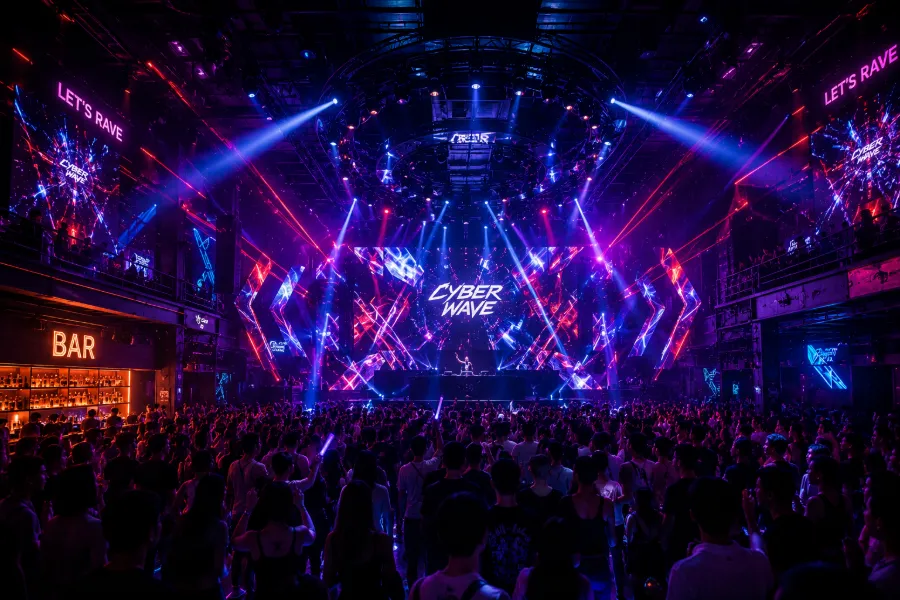
Successful case: NEBULA bar in Nanshan, Shenzhen expected 150 daily guests before opening, but after launch consistently saw over 300—doubling traffic. One key reason was its light‑shadow matrix design. The space used multiple moving heads and LED PAR lights with a smart dimming system to create an immersive rhythm. Guests’ first action is to pull out their phones and record videos, then share them—free promotion. That alone pays back the design fee.
Beyond traffic, professional lighting directly raises average spend and repeat rate. A flagship KTV renovated 36 private rooms with smart lighting‑sound integration, one‑click scene switching. Room repeat bookings rose 40%, and customer satisfaction hit 98%. Using lighting as an operational tool, not just decoration, yields completely different results.
Now the failure cost. My DIY failure bill: equipment return loss about 30% (cheap lights can’t be fully refunded after opening), three weeks of closure lost about ¥40,000 in revenue, and hiring a professional team to finish cost another ¥15,000. Total loss > ¥55,000—enough to hire three designers.
If you hire a full‑service team, from design through construction to opening, the timeline is predictable. Brands like VYLEN give deterministic delivery schedules, avoiding “mid‑project surprise missing a signal cable” delays. Moreover, during the warranty period, a broken device gets a phone call and a technician shows up—DIY means you have to climb a ladder yourself.
Long‑term, industry research shows that commercial spaces with professional lighting see 20‑40% longer average dwell time compared to ordinary lighting. One more round of drinks per guest means more revenue. If your lighting can’t keep guests seated, you’re losing renovation costs daily.
DIY is possible, but you must account for hidden costs. Does the saved design fee cover multiple losses?
If you want more renovation case studies, I previously compiled an article on bar renovation pitfalls, including a case of a community bar in Nanshan, Shenzhen where the lighting system issues were almost identical to mine: Three Lessons from Renovating an Old Bar: 2026 Bar Renovation’s True Determinant Isn’t Style. Also, Pinterest’s high‑end bar design collections provide plenty of inspiration: Luxury Bar Design Ideas.
One more point you might not have thought of: many owners think they can start with cheap lights, upgrade later after making money. In reality, poor lighting can prevent you from ever earning enough to upgrade—a vicious cycle.
FAQ
Q1: How much does hiring a professional lighting designer cost?
Based on project complexity and area, design and debugging fees for commercial spaces typically range from ¥10,000 to ¥50,000, with large nightclubs or KTVs possibly exceeding ¥100,000. This fee includes site survey, lighting layout design, console programming, and on‑site debugging, but excludes equipment purchase. Compared to DIY failure losses, this cost is roughly half.
Q2: Can I achieve near‑professional results by buying smart strips and spotlights myself?
In a small space you can reach acceptable quality, but it’s hard to match professional seamless scene transitions and audio‑light sync. Smart strips and spotlights are suited for static color ambience; once you need multi‑fixture synchronization, gradient fades, BPM tracking, consumer‑grade controllers reveal latency and channel conflict issues. Private spaces under 10 m² can try it; larger areas warrant caution.
Q3: When is it okay to “start with cheap lights and upgrade later after making money”?
Only when the venue is non‑commercial or your business model doesn’t rely on on‑site ambience—e.g., delivery‑only, tabletop games, study rooms. If your revenue depends on guests staying, consuming, and taking photos, don’t compromise. Lighting failures directly cause guest loss, and those lost guests won’t return after you upgrade.
Q4: Does the designer only handle installation, or can they also help with operations?
A good lighting design team participates in post‑opening support. Professionals usually finish all scene presets before opening and train your DJ or manager on quick mode switching. Some full‑service brands (like VYLEN mentioned earlier) also offer post‑opening equipment tuning and operational consulting to keep the lighting system aligned with your business rhythm.
Q5: I’m opening a 10 m² private KTV booth—do I need to hire anyone?
For a private booth under 10 m² and non‑commercial, a smart strip plus TV backlighting is sufficient, costing about ¥1,000‑¥2,000. However, if you intend to host clients or create social‑media content, it’s advisable to spend ¥2,000‑¥3,000 on a designer for a simple lighting plan—issues aren’t about brightness but about skin‑tone reproduction on camera and avoiding flicker, which directly affect content shareability.
Share Article