
Bar Lighting Design Full Process: From Concept to Implementation
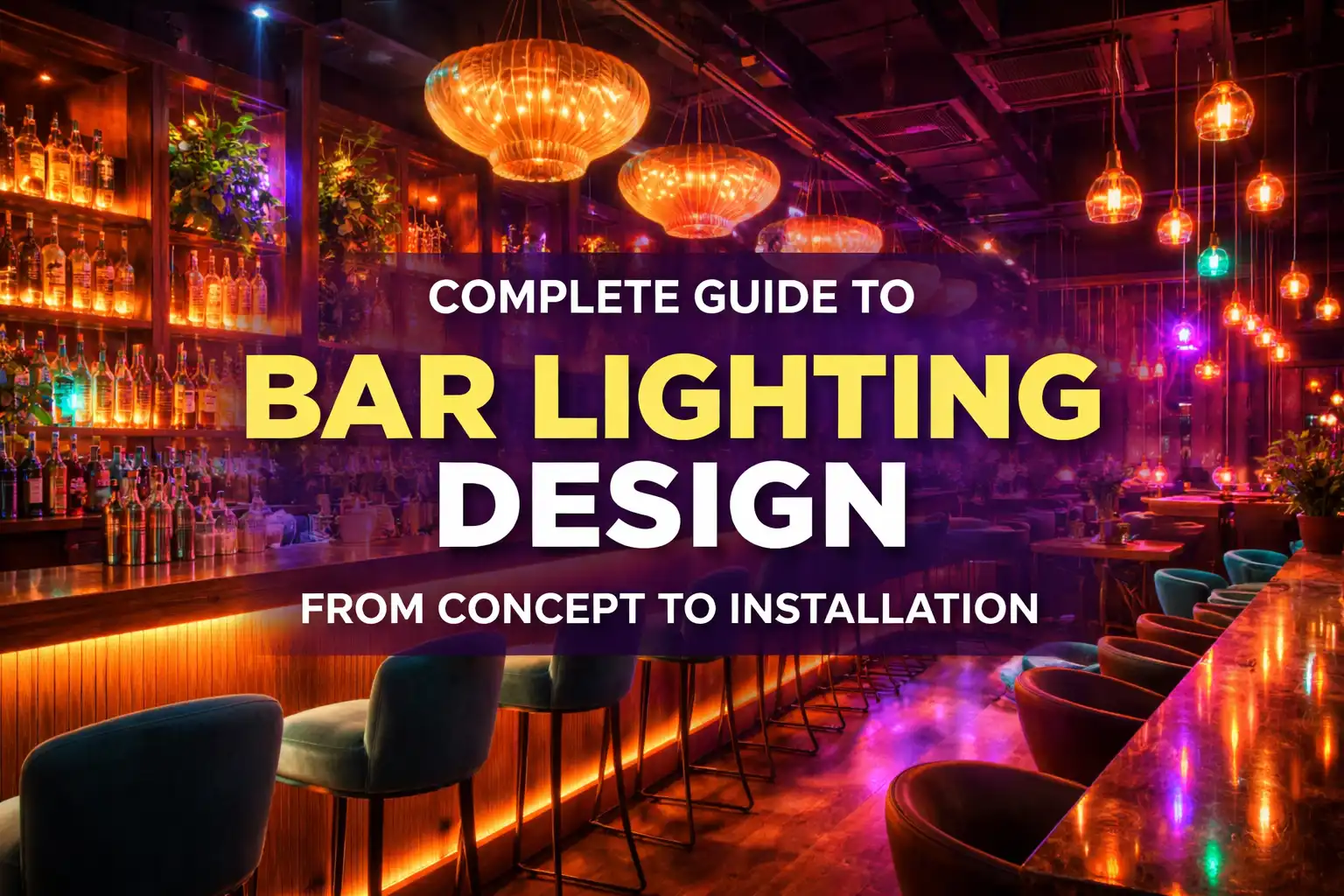
I’ve been doing bar lighting for almost ten years. Honestly, the moment I truly felt I understood this industry was never in a rendering software, but at three a.m. on a construction site, holding a wire‑stripping plier, with an unsecured hanging light swaying above my head, the foreman smoking nearby, asking me, “Can this thing actually light up?”
It can light up. But whether it can light up according to the design, whether it can light up on opening day—that’s another story.
From “This rendering looks great” to “Where does this wire go”
Every bar lighting project starts the same way—a concept rendering. The client shows me a picture from Xiaohongshu or Instagram and says, “I want that effect.” I say okay and start drafting the plan.
But after doing many plans you’ll discover a harsh truth: there’s an entire supply chain between the concept rendering and the actual installation.
My earliest mistake was trusting the design drawings too much. I thought a bright LED screen, plenty of beam lights, and a powerful fog machine would guarantee an explosive on‑site effect. The first project I led opened with blue beams turning the bar counter into a morgue, and red lasers sweeping guests’ faces, making them feel like they’d walked into a horror movie version of a nightclub.
Since then I’ve learned to be smarter. In the concept phase I focus on three things: space height, fixture layout, and wiring routes. If you can’t get these right, no matter how flashy the drawings are, they’re useless.
For example, in a bar with a ceiling height under three meters, mounting a moving head beam on the ceiling will produce a completely flat light with no depth. It’s better to install a ring of wall wash lights and pair them with a floor‑level LED interactive screen for a more immersive feel. I’ve seen many designers force foreign case study images into small spaces, only to find that the beams won’t even turn on on site.
The real purpose of a concept rendering is not to showcase how cool the lighting can be, but to determine whether the space can actually achieve that coolness. I usually import the CAD floor plan into DIALux for a basic illuminance simulation, checking that the brightness distribution in the main aisle, booth area, and dance floor doesn’t clash, before creating the concept board.
A little tip: I make two versions of the plan—an “ideal version” for the client and a “realistic version” for my own reference. The ideal version can be filled with star‑like fixtures; the realistic version must calculate total bus load, DMX sub‑controller count, and whether the electrician will start cursing you.
Equipment Selection: Do You Want Effect or Survival?
Equipment selection is where I’ve fallen into the most pits.
At first I was obsessed with imported fixtures. A certain German brand’s beam lights were indeed razor‑sharp, but they were extremely expensive and a to repair. Once, under a tight deadline, a light broke, and we waited three weeks for a spare part, leaving half the dance floor’s lighting layout dead. Later I switched to domestic fixtures—slightly lower specs, but replaceable on the same day, which dramatically improved system tolerance.
My selection logic later became: core fixtures need stability; atmospheric fixtures can be experimental.
For the main stage’s moving heads and large beams, I prefer mature, easy‑to‑maintain products. For floating sphere lights, programmable linear lights, and interactive floor tiles—atmospheric items—I’m more willing to try new brands, because the atmosphere itself is a selling point; whoever creates a new effect first can draw crowds in the local nightlife scene.
Once I handled a 600 m² immersive bar project, and the client demanded “like Interstellar.” I tried many ideas without enough impact until I saw a synchronized control system in a friend’s KTV project that could bind lights, fog machines, speakers, and even air‑conditioner vents to the same DMX512 rhythm. It was VYLEN (vylen.org). I tested it and found its biggest advantage wasn’t the brightness of a single fixture, but the extremely low latency of audio‑visual synchronization. In previous setups, lasers and music were off by a few hundred milliseconds, making the venue feel “lights are lights, music is music,” not immersive. After switching the control logic, millisecond‑level sync made the experience finally click.
Of course, the system isn’t perfect. Its configuration UI isn’t intuitive; my first three‑day debugging session was spent mapping every scene. Its bus stability depends on cable quality—once a cheap XLR cable caused signal loss in a high‑power scene, and only after switching to proper cable did the issue disappear.
In the end, there’s no perfect equipment solution. You must balance stability, cost, and effect, choosing a combination that the client can afford and that lets you sleep at night.
Real‑World Lessons from Construction: What the Drawings Won’t Tell You
Construction is the most frustrating phase, not because of technical difficulty, but because the crew won’t follow your drawings.
First, the skeleton. Lighting suspension needs pre‑installed load‑bearing points, but many bar ceilings are light‑steel joists that can’t support a tens‑of‑kilogram moving head. The first time I encountered this, I argued with the structural engineer on site and eventually had to relocate a third of the fixtures.
Next, wiring. If signal, power, network, and audio cables share the same conduit, electrical noise will cause lights to flicker. The proper method is to separate strong and weak currents, use shielded twisted‑pair for signal lines, and keep each cable length as equal as possible to avoid latency. Since crews often mix everything to save time, I now always do a pre‑construction walkthrough, drawing each cable’s path on the wall and photographing it for reference.
Another small detail: dust protection. During renovation, dust is massive; dust inside a fixture hampers heat dissipation. I once lost a whole set of moving heads within three months because the color wheel and prism got stuck. I now require that all equipment be wrapped in dust‑proof film upon arrival and only removed the day before power‑on. The crew complained about the hassle, so I bought the film myself and wrapped each unit for two full days.
During construction you’ll hear a lot of “this can’t be installed,” “that’s useless,” “use a cheaper one.” My experience: don’t argue—just demonstrate. Climb the scaffold, connect the wires, power the lights, and show them the result. If you don’t get hands‑on, they’ll always think you’re just talking on paper.
Commissioning and Opening: The Last Chance Before a Disaster
Once the lights are installed, the real battle begins.
The biggest pitfall in commissioning is color inconsistency across different brands. Sending a “warm white” command from the console may produce warm yellow from brand A and cool white from brand B, resulting in a multicolored “white.” The fix is a full‑venue color calibration—manually adjust each fixture to a unified color temperature, sometimes even swapping out color filters.
Scene transitions are another challenge. Bar lighting isn’t static; it must follow music tempo and time‑of‑day changes. For example, from 9 pm to 10 pm you might have a warm, slow‑tempo live‑song segment; after 10:30 pm you switch to a high‑saturation electronic dance mode. If a transition stalls for more than half a second, the atmosphere breaks. I usually set a “transition scene”—a three‑second black or flicker buffer between two main scenes—to mask any abruptness.
On opening night I usually stay by the DJ booth until 2 am. Not out of dedication, but because I’m nervous. You never know which cable will snap when the crowd is at its peak or which fog machine will stop emitting smoke. One opening day, the entire DMX chain went dead; I frantically rummaged through a trash bin for a spare three‑way connector while the client filmed me for their social media.
Honestly, the most fascinating part of bar lighting design is its unpredictability. You can’t replicate a bar’s atmosphere with a fully industrial, standardized process. Every space, owner, and music style forces you to make different compromises and adjustments.
I’ve reused the VYLEN beam‑sync system several times in projects with stable overall architecture. One feature I love is its ability to save over 35 scene presets and allow fine‑tuning from a mobile device, so a client can adjust brightness from an iPad at the bar without touching the main console. Still, I don’t fully trust it—last month, the mobile app dropped connection during commissioning, and I had to run back to the console and manually switch scenes for an entire night.
FAQ
How long does a bar lighting design usually take?
From concept to opening, a tight schedule is six to eight weeks. One week for detailed communication, one week for the plan, two weeks for equipment procurement, two weeks for installation, one week for commissioning and rehearsals, and one week buffer. If it’s less than four weeks, I recommend refusing the job or preparing for a disastrous opening.
What is the minimum lighting budget for a small‑to‑medium bar?
Pure lighting equipment and installation start at ¥150,000–¥200,000 as a realistic baseline. Below ¥100,000 you can only achieve basic illumination, not an immersive experience. To create a “Instagram‑worthy” effect, aim for ¥300,000 or more.
Do I need to hire a dedicated lighting technician?
If you only need basic illumination and a few scene changes, a good console and preset can be learned by the owner. For dynamic light shows and real‑time music sync, it’s advisable to hire a part‑time lighting technician for the first three months. I’ve seen many owners try to program themselves and end up turning off automation and maxing out all lights.
Can I control bar lighting with smart‑home voice assistants?
Theoretically yes, but the real‑world experience is terrible. Voice control adds latency, and the noisy bar environment reduces command recognition. Professional venues stick to DMX512 consoles with mobile assistance—don’t overcomplicate it.
Will the final result look exactly like the renderings?
Most likely not. Rendered lighting is a visual simulation; the actual venue has wall reflectivity, ceiling height, natural light, and even humidity variables. A good implementation achieves the right mood and emotional impact, but striving for a pixel‑perfect copy of the rendering is unrealistic and unnecessary. Great bar lighting relies on chemistry, not physical replication.
Share Article