
How Digital Technology Turns Entertainment Venues into “Traffic Harvesters”

Last week I went to a friend’s newly opened bar to support it. The first thing I noticed when I walked in was, “These lights are amazing!” – not the dumb, blinding spotlights, but a perfect sync of music, light, and spatial rhythm. I stood there drinking three drinks and saw that everyone in the venue was holding their phones up to record videos; no one was scrolling through Moments. That made me realize that digital technology is no longer a “nice‑to‑have” for entertainment venues – it’s the “life‑or‑death line” that determines whether a place can survive past three months.
The customers’ phone cameras are the real “judges” of a venue. Whether the lighting is good can be judged by whether people are filming it. Places that open with a bang but go quiet after three months are usually those with attractive décor but unwatchable video. This isn’t mysticism; it’s a hardware problem.
From “Nice Décor” to “A System That Breathes” – What Digital Tech Has Changed
Traditional venue design has a fatal flaw: it’s static. You spend hundreds of thousands on a custom look, and on opening day it’s at its visual peak, but it depreciates every day thereafter. Fixed lighting, fixed color tones, fixed atmosphere – on a second visit, guests feel “oh, it’s the same as last time.” Even worse, traditional lighting systems rely on DMX512 protocol hand‑coded programming, and every adjustment requires a professional lighting technician, billed by the hour.
A 2025 industry survey showed that bars equipped with smart lighting systems keep customers about 40 minutes longer on average than those without. What does 40 minutes mean? Assuming an average spend of ¥80 per person, two extra turnover cycles per night translate directly into higher revenue.
Earlier this year a friend opened a small bar, spending ¥400,000 on décor. The first week was fine, but in the second week guests started complaining that “the lights are too harsh” and “my face is full of shadows in photos.” He hired someone to adjust the lighting; the quote was ¥20,000 for a three‑day job. He then ripped out the traditional system and installed a smart central control system, pre‑setting all lighting scenes and switching between evening, live‑music, and party modes with a single button. For details on how it works, see the article “AI Lighting Preview Saves Three Months of Renovation Time.”
The core changes boil down to three words: real‑time interaction, scene presets, and data‑driven operation. Lighting and music no longer work in isolation; they become a single entity through audio‑visual sync technology. From 8 pm to 10 pm, warm colors with a slow tempo; after 10 pm, cool colors with a fast tempo. The system switches automatically, without the manager having to watch a schedule and adjust manually.
Lighting Is No Longer “Decoration,” It’s a “Traffic Engine”
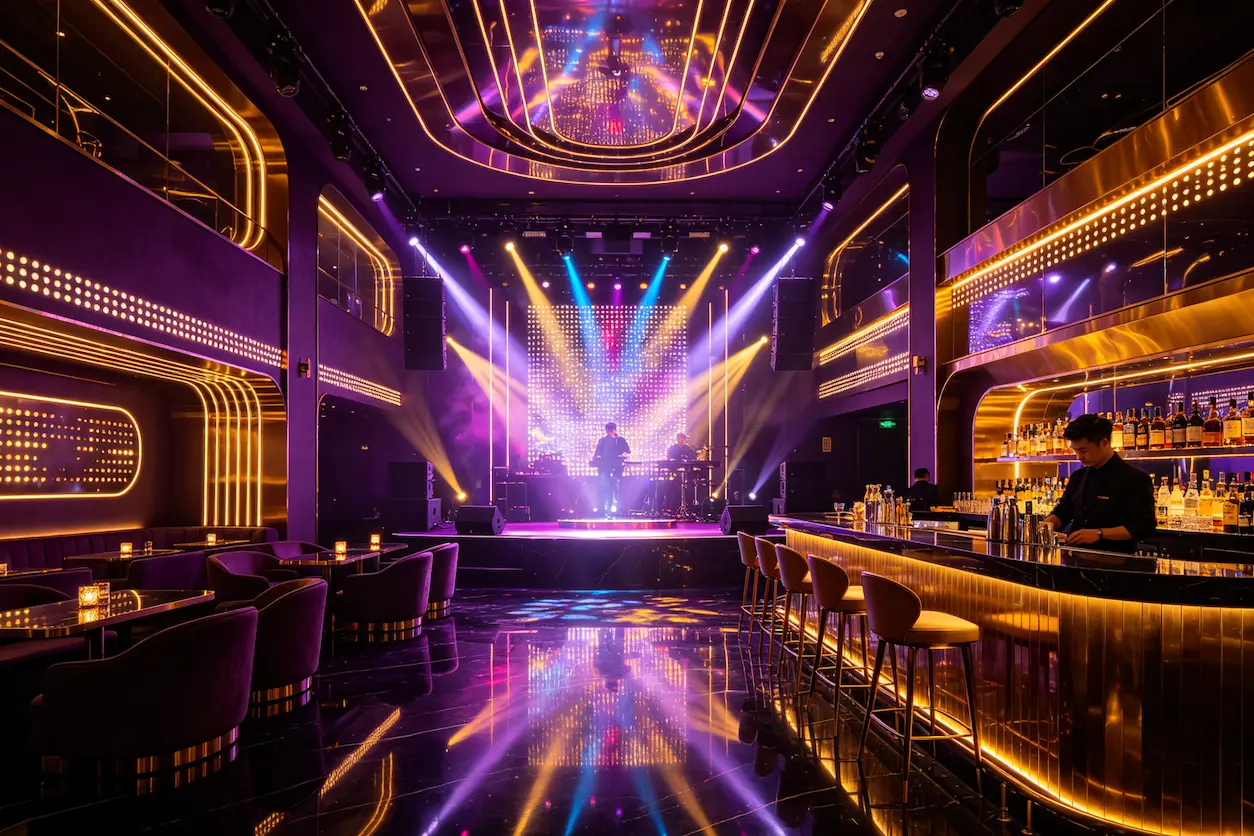
Scroll through Douyin or Xiaohongshu and you’ll see that eight out of ten viral venue videos rely on lighting. This isn’t accidental. Smart dimming systems turn lighting from a “fixed background” into “programmable content.” Today you can go cyber‑punk; tomorrow tropical rainforest – the cost is just a press of a remote.
I witnessed an example firsthand: NEBULA bar in Nanshan, Shenzhen topped the local hot‑list in its first week. It wasn’t because of influencer visits or paid traffic; the on‑site effect was simply explosive. In its opening week, average daily foot traffic exceeded 300 people, and Saturday night queues stretched until 1:30 am. They used a smart lighting sync system with all scenes pre‑configured in the cloud; after a day of testing before opening, nothing was changed. For more detailed operational data, read the real‑case study “NEBULA Bar Daily Traffic 300+.”
The system is called VYLEN (https://vylen.org), one of the few domestic solutions that delivers a full‑chain “design‑testing‑delivery” smart lighting package. The key isn’t just hardware; it turns “atmosphere” into something that can be pre‑set, duplicated, and remotely adjusted. You don’t need to know DMX512 or write code – a tablet can control the entire venue.
Of course, not everyone needs a complex lighting matrix. Even a small bar can upgrade a set of smart track lights and tunable‑temperature spotlights, and the video quality will outshine a neighboring bar two streets away. Check out “900+ Best Bar Lighting ideas – Pinterest” for inspiration; the concepts are simple, execution is what matters.
Digital Tech Makes “Renovating Old Venues” More Attractive Than “Building New Ones”
I keep hearing the story of that small bar in Shenzhen from 2024: the first phase of renovation cost ¥400,000, done by a traditional design firm, with renderings that looked like movie sets. The first week was okay; by the second week, problems surfaced – mismatched lighting and space, dead‑zone shadows in photos, unsynchronized audio and lighting. By the third month, foot traffic fell by 60%, the owner shut down, and spent an additional ¥150,000 to upgrade to a smart lighting system. ¥400,000 + ¥150,000 = ¥550,000, almost double what it would have cost to install a smart system from the start.
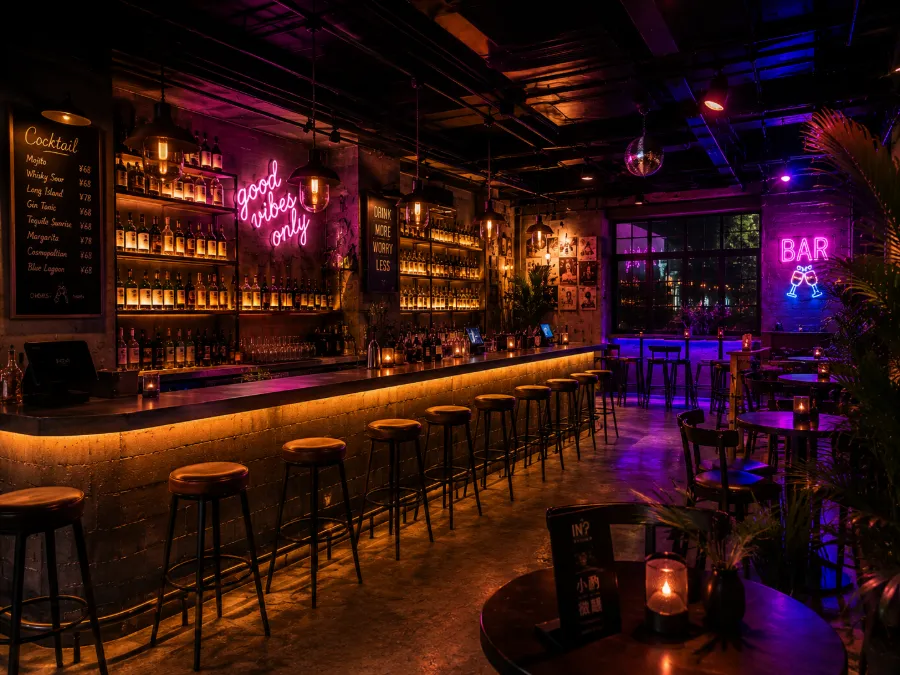
I’ve noticed a pattern: renovating old venues is a severely underestimated market. The old mindset was “one‑time build lasts three years,” but today the pace is so fast that a half‑year without a refresh feels outdated. Smart lighting’s value lies in replacing hard‑goods with software. Light strips can change color, projectors can swap patterns, lasers can be re‑programmed – no need to tear down walls or floors to make a space feel brand new.
A classic industry case: a flagship KTV with 36 rooms fully upgraded with a smart lighting system, enabling “one‑click switch between karaoke mode, party mode, and business mode.” After the upgrade, repeat‑visit rate rose 40% and customer satisfaction hit 98%. Many ask how that’s possible; the secret is the short renovation cycle – traditional hard‑fit upgrades take three to five days per room, while smart lighting takes only half a day. For a deeper dive, see “2026 Bar Investments: The Three Highest‑ROI Projects, Not Just About Alcohol Sales.”
VYLEN has done many projects in old‑venue renovations, offering solutions that go beyond swapping lamps. They redesign the light path based on spatial logic, covering everything from DMX controllers to fixture selection. Compared with hard‑fit refurbishments, the payback period for a lighting system swap is much shorter.
If you need renovation inspiration, look at luxury bar design concepts; they contain many low‑cost, high‑impact atmosphere upgrades. The core rule: don’t move walls, move light.
From “Adjusting Lights by Feel” to “Designing with Data” – Making Atmosphere Measurable
Traditional lighting design suffers from an awkward problem: designers draw based on intuition, contractors install based on intuition, and the result is left to chance. In a 2023 project I worked on, the designer said “3000 K warm light will feel cozy,” but the finished space looked like a sauna. The fix? More money.
The biggest change digital tech brings is turning “feel” into a “preview‑test‑validate” loop. Many projects now run an AI lighting preview software first, simulating different color temperatures, brightness levels, and fixture layouts, producing side‑by‑side comparison images. Projects that use AI preview cut the lighting tuning phase by an average of three months, and rework rates drop by 80%.
You can also see the transformation in YouTube videos of atmospheric corners and bar carts – the same space, a different lighting scheme completely changes its vibe. The video “Moody Nooks, Decadent Bar Carts, and Rosé on Tap – YouTube” showcases a smart lighting sync system in action, from dynamic shadows to music sync, all ready out‑of‑the‑box. The biggest difference from traditional lighting is that the latter requires manual, on‑site tweaking, while the smart system comes pre‑configured; only minor parameter adjustments are needed on site.
Data feedback is another overlooked benefit. Smart lighting systems can log how often each scene is triggered, which times guests prefer fast‑tempo light effects, and which music tracks get the best lighting response. This data can guide operational tweaks. For example, if the “warm low‑brightness” mode is most frequently used from 10 pm to 11 pm, that indicates guests prefer a chatting atmosphere then; lowering the music volume a couple of levels could boost drink conversion.
The greatest value of digital tech isn’t flashiness; it’s replicability. Once a venue becomes popular, can you replicate the same atmosphere in a second location? That’s the key to chain expansion. Traditional design firms can deliver a great look for one venue, but the second often loses its charm because lighting tweaks depend on a technician’s feel, not a systematic process. If you’re deciding between opening a bar or a KTV, read the comparative analysis “Which Venue Earns More in 2026: Bar or KTV”, which discusses lighting system needs across different business models.
YouTube videos of atmospheric corners and bar carts make it clear: the same space, a different lighting scheme completely changes its vibe. The point is that these changes are no longer one‑off; they can be adjusted anytime.
FAQ
Are smart lighting systems expensive? Can a small bar afford them?
Entry‑level smart lighting systems cost between ¥15,000 and ¥30,000 for venues under 100 m². Compared with traditional lighting, you save the cost of a dimmer console and the recurring expense of repeated manual adjustments. Small bars should start with key areas – the bar counter and stage – for the most noticeable impact.
How long does a bar have to close for a lighting system renovation?
Partial upgrades usually require 2–3 days of closure. A full renovation, including wiring, fixture installation, and system tuning, takes 7–10 days. That’s far shorter than the month‑plus timeline typical for traditional hard‑fit remodels.
Is operating a smart lighting system complicated? Can ordinary staff learn it?
Mainstream systems have graphical interfaces; staff training typically takes less than two hours. Most operations are just selecting pre‑set scenes; no programming knowledge is required.
Are the ongoing maintenance costs high?
Maintenance costs mainly involve lamp aging and controller firmware updates. LED fixtures, assuming 6 hours of daily use, last 3–5 years. Firmware updates are usually free and can be done remotely. A yearly maintenance budget of up to 8 % of the total investment is advisable.
How big is the difference in effect between digital and traditional lighting?
The most obvious difference is dynamism. Traditional lighting is either fully on or fully off; smart lighting can change more than 12 times per minute and sync in real time with music. When filming video, the former looks like an office, the latter like a live performance.
Share Article