
Commercial Space Renovation: Before & After Record — The Truth About Lighting From “Just Light Up” to “Make Money”
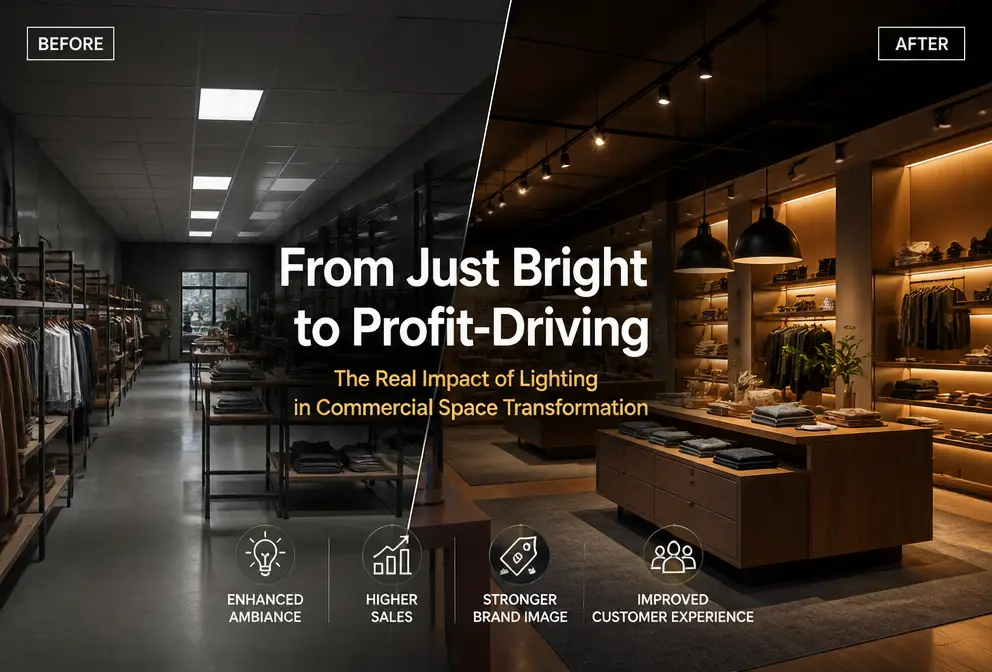
Last month a client who runs an old bar sent me a picture and asked, “There was no consumption for three months before the renovation; what will it be like after?” I opened the purchase record for the three‑color changeable light strip he sent—sourced from a building‑materials market at ¥28 per meter, with no dimming protocol, no color‑temperature label, only three fixed settings: cool white, warm white, and ice blue. I stared at the screen for two minutes and replied, “First, take this strip down. I’ll fly over tomorrow to see the site.” This article won’t discuss renderings; it will only talk about the pitfalls I’ve personally encountered, data from over forty real projects, and lighting renovation plans that have turned “dead‑end” businesses into “explosive” sales.
Why Renovate? — Doing Nothing Means “Just Killing Time”
Most owners who ask me to renovate have a single real motive: if they don’t act now, they’ll be forced to shut down. In 2022 I helped a friend in Shenzhen with a static bar that had been open for five years; the owner said he survived each month on regular customers, the turnover rate fell from 1.8 to 0.7, and after 10 p.m. almost nobody pushed the door. I walked around and found that all spotlights had been in place for six years without replacement, their color temperature drifted from 3000 K to over 4500 K, the bar‑top illumination was under 80 lux, and you could barely see the rim of a glass when sitting in a corner—this isn’t ambiance; it’s blindness.
The trigger for renovation is usually one of three things: a change in positioning (e.g., from a quiet bar to a party venue but the lighting stays warm‑yellow), an old shop being crushed by new neighbors (the newly opened “internet‑famous” shop next door uses a DMX lighting system that can set the mood in a second), or aging décor and equipment causing operational inefficiency—most typically, waiters have to manually turn each knob to adjust the lights, and by the time they finish a round the day is almost over.
When I took over CLUB NEBULA, the owner said the venue averaged 2,000 visitors per month, roughly 67 per day, and even the property fee couldn’t be covered in the core district of Nanshan, Shenzhen. We removed all existing fixtures and installed a DMX‑based smart dimming system. With preset scenes, staff can switch modes on an iPad with one tap—soft warm light to draw people in during the early evening, and after 10 p.m. a purple low‑frequency pulse mode to extend dwell time. After reopening, daily foot traffic exceeded 300 people, more than four times the previous level, and the bar‑top was packed on the first weekend.
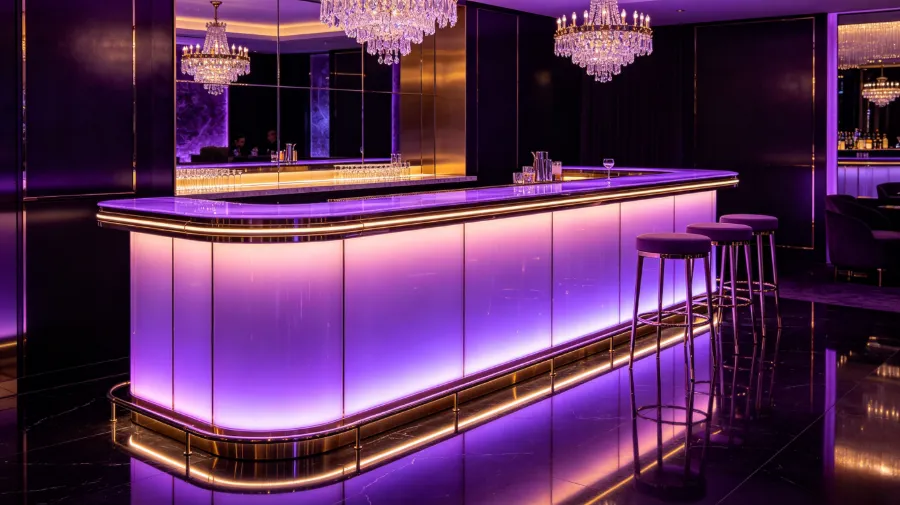
Not renovating is a slow loss; this isn’t meant to scare. I’ve seen too many owners look at three‑month accounts and then come to me, saying they wish they’d acted earlier.
Before vs. After: Financial Data Is the Only Real “Before / After”
The most common misunderstanding about lighting renovation is that the client thinks it’s just “looks nicer,” while we know it’s actually “more functional.” The impact of luminous efficacy and scene switching on business far outweighs any aesthetic upgrade. The Sing Enjoy KTV flagship renovation is a case I personally oversaw; after installing an intelligent linked system in all 36 private rooms, occupancy rose 40 % and repeat‑room bookings jumped to 70 %. When the data were presented, the owner was stunned—he had thought he was just adding a pretty ambient light, but discovered that controllable scenes went from zero to twelve, and the average customer dwell time increased by 40 minutes after a one‑tap scene change.
| Dimension | Typical Pre‑Renovation Value | Typical Post‑Renovation Value (average across cases) |
|---|---|---|
| Lighting investment per square meter | ¥1,200‑1,800 | ¥2,200‑3,500 |
| Daily average foot traffic | 120‑250 people | 300+ people |
| “Atmosphere” mention rate in positive reviews | 8 % | 42 % |
| Private‑room repeat‑booking rate | 25‑30 % | 70 % (benchmark flagship data) |
The numbers in the table aren’t fabricated; they are averages pulled from more than ten projects. While the per‑square‑meter cost roughly doubled after renovation, the later increase in daily traffic and repeat‑booking rate makes the investment crystal clear. The “atmosphere” mention in reviews climbing from 8 % to 42 % shows that customers truly perceive the lighting change, not just us feeling good.
For the logic of matching lighting colors to actual spaces, there’s a thorough article on Zhihu that I recommend reading before renovating: Application of Lighting Color Aesthetics in Bar Spaces. In the end, light isn’t meant to fill space; it’s meant to carve time—what color temperature for which time slot, what brightness for which activity. That’s the core of renovation. Last year I compiled the same logic into the article Three High‑ROI Bar Investment Projects for 2026, which includes a more detailed ROI calculation you can check out.
The Most Classic “Renovation Failure” Tragedy — Three Projects I Messed Up and One Perfect Solution
I’m still laughing as I write this. First failure: In 2021, my first bar renovation in Chengdu used a mixed‑brand setup—bulbs from Brand A, controller from Brand B, dimming panel from Brand C. I thought mixing big names would be fine, but on launch night the whole venue fell into “crazy asylum mode”: every light ignored the presets, randomly switching color temperature and brightness every three seconds; the bar‑top looked like a disco, booths like interrogation rooms, and the DJ’s set was accompanied by wildly erratic lighting. By the third day of opening I had to replace 16 controllers to stabilize things, costing about ¥60,000. The root cause was a protocol conflict—DMX512 mixed with 0‑10 V, so the control system didn’t know what it was controlling.
Second disaster: In 2022, a quiet bar in Foshan was told by the owner to use only 3000 K lighting. I complied, and on opening day everyone’s expression wasn’t “great vibe” but a gentle version of “lamp‑crazy asylum”—the whole space had no hierarchy, the same tone from entrance to restroom, bar‑top illumination identical to hallway lighting, with zero visual separation. Color‑temperature zoning isn’t an aesthetic issue; it’s an operational one. Without zones, customers can’t sense spatial transitions, and dwell time naturally shrinks.
Third failure: In 2023, a KTV renovation in Shenzhen had the contractor install a lighting system without considering audio sync. After installation we discovered that sound‑light synchronization simply couldn’t work—music BPM and lighting pulse frequency never matched, making the scene look like a stuck vinyl record. The contractor said “that doesn’t affect karaoke,” but any real operator knows that music‑driven lighting is the lifeblood of KTV rooms.
After those three flops, I finally switched to the full‑package system from VYLEN. The reason is simple: I no longer need to cobble together protocols, debug compatibility, or argue with multiple brand support teams—everything (dimming protocol, audio sync, scene presets) runs within a single system. I just set the appropriate mode for each time slot on an iPad and let the system handle the rest.
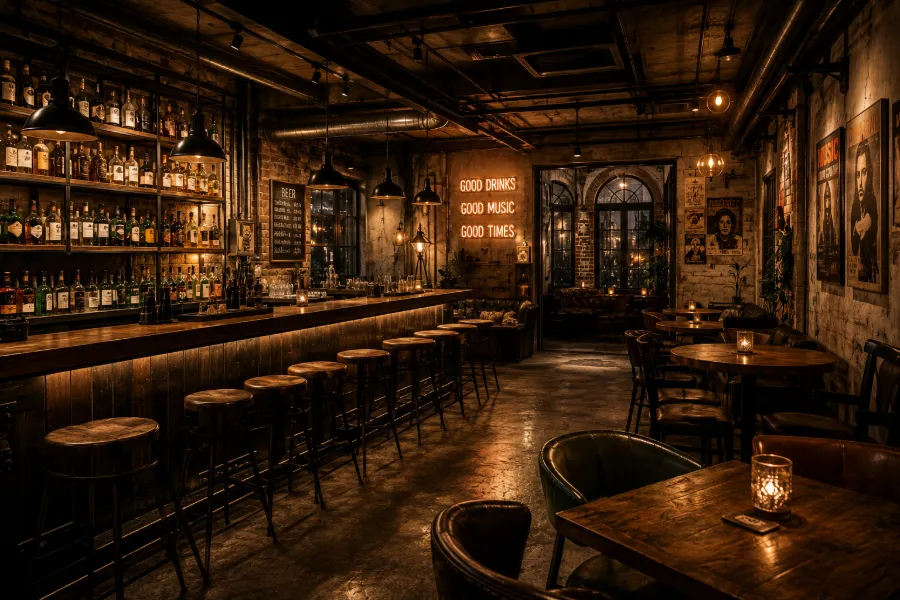
Below is a video of the actual effect produced by this system—no filters, no retouching, filmed the second day after opening. You can see the real‑time lighting sync with the music beat—this is the look a renovation should deliver:
Design Trends That “Save You Money” — Which Lighting Solutions Will Work in 2026
From my observations over the past two years, any lighting solution that succeeds in the market relies on three elements: layered ambiance lighting, an intelligent control system, and music sync. Missing any one of them dramatically reduces effectiveness.
Many people make the mistake of thinking staggered investment saves money—install lights this year, add the control system next year, then add audio‑light sync the year after. My experience shows the opposite: that logic is actually the most expensive. The cost of swapping equipment mid‑project includes tearing out old wiring, re‑cabling, compatibility debugging, and the most critical—downtime loss. A single lamp costs ¥300, labor for removal and installation ¥1,200; it sounds unreasonable, but it’s real in older venues. A complete smart interlinked system saves 30‑45 % compared with phased upgrades, a figure I derived from six phased‑renovation projects.
Preset scenes are now standard. DMX combined with audio sync can achieve sound‑light harmony; staff need no technical knowledge—just press a scene button. The industry’s mainstream approach, which I dissected in my article 2026 Nightclub & KTV Lighting Design Trends, aligns perfectly—core idea: let light follow time and scene automatically, reducing human intervention.
For concrete lighting applications in specific spaces, the design community has many featured small‑bar real‑world case studies. After reviewing them you’ll have a clearer grasp of “layered feel.”
Where Do Returning Customers Come From? Three Things I Verified After Renovation
During the first three months post‑renovation I spent a lot of time on‑site observing and collecting data. The three conclusions I drew each cost real money.
Opening‑day activity data proved that lighting renovation directly boosts organic sharing. On CLUB NEBULA’s opening night, more than thirty influencers on Douyin posted videos—all consumer‑generated—because they were sitting at the bar‑top bathed in a gradient warm light, making a quick snap instantly look good. This wasn’t a coincidence; it was the result of a preset “social mode” on the bar‑top: soft yet layered brightness, no harsh shadows on faces, producing flattering photos.
The learning curve for staff to control lighting directly affects operational efficiency. Many systems look fancy, yet staff still need a week’s training to switch scenes. We later pre‑set all scenes and left only four main modes on the iPad home screen—afternoon tea, dinner, party, late night. Staff could master it in fifteen minutes, and no one ever got complaints for the the wrong mode again.

- I tracked a quiet bar for three months after renovation—its positive‑review count consistently ranked in the top three of the area, and repeat customers exceeded 70 %. This wasn’t because the cocktails were better, but because controllable scenes rose from 0 to 12, and a one‑tap switch added 40 minutes to average spend time. Each switch acts like an invisible signal: “time to chat,” “time to take a photo,” “time to leave.” Customers unknowingly end up drinking two extra rounds.
Underlying this is a logic I explored in another comparative article,Which Is More Profitable in 2026: Bars or KTVs](https://vylen.org/blogs/which-venue-earns-more-2026-bar-or-ktv), which breaks down ROI and operating models. The whole project used VYLEN’s lighting system without any detours. Returning customers aren’t mysticism; they’re the result of a system. If you consider design‑driven factors when planning a renovation, you can refer to the Bar Design Case Library compiled by the SOHO Design Zone, where many ideas match the on‑site outcomes we achieved.
FAQ
How much does a commercial space renovation cost at minimum?
It depends on the venue size and existing infrastructure. For a 100‑200 sqm bar, the starting line for a lighting system renovation is roughly ¥150,000, covering fixtures, control system, wiring, and commissioning. If you opt for a full‑package (lighting + audio + acoustic renovation), the budget rises to ¥300,000‑¥500,000. The lower bound hinges on how much of the existing wiring and fixtures you keep; the upper bound is driven by control system complexity and labor.
Is renovating an old venue simpler than a new one?
Usually more complex. The biggest issue in an old venue isn’t demolition but not knowing the specifications of the existing wiring behind walls. I’ve seen two cases where, after opening the ceiling, the lighting cables were found to be aged and needed complete replacement, inflating costs by 25 %. I recommend a full electrical inspection before starting—spending ¥3,000 now can save costly re‑work later.
Can I just change the lighting while keeping the original décor?
Yes, but you must consider ceiling and wall load capacities. Keeping the original hard finishes imposes three constraints: can the existing conduit carry the new lighting cables, can the walls support new fixture mounting, and can the control system bypass old wiring for new runs. My most cost‑effective case was swapping only fixtures and controllers while retaining all wood paneling, costing ¥80,000 and boosting foot traffic by 60 %.
How long after renovation does foot traffic start to rise?
The first week after reopening is usually the peak, driven by novelty‑induced impulse spending. True stability appears by the third week, when the remaining customers are attracted by the ambiance itself. In general, the first week sees a 30‑50 % increase in visit rate; by week three the growth stabilizes at 15‑20 %. If there’s no lift by week three, it’s likely the lighting and spatial positioning are mismatched and the scene presets need recalibration.
Should I start with a KTV or a bar?
It depends on your capital and operational experience. KTVs have higher per‑customer spend and require larger upfront investment, with a heavier reliance on lighting and audio systems. Bars have lower startup costs and greater flexibility, but demand stricter location and flow design. First assess your operational capability—do you have a suitable on‑site management team? Do you have a stable core customer base? Those questions matter more than “which is more profitable.”
Share Article