
Case Analysis: The Light-Image Matrix of Shenzhen NEBULA Bar, the Traffic Secret Behind Its Grand Opening Success
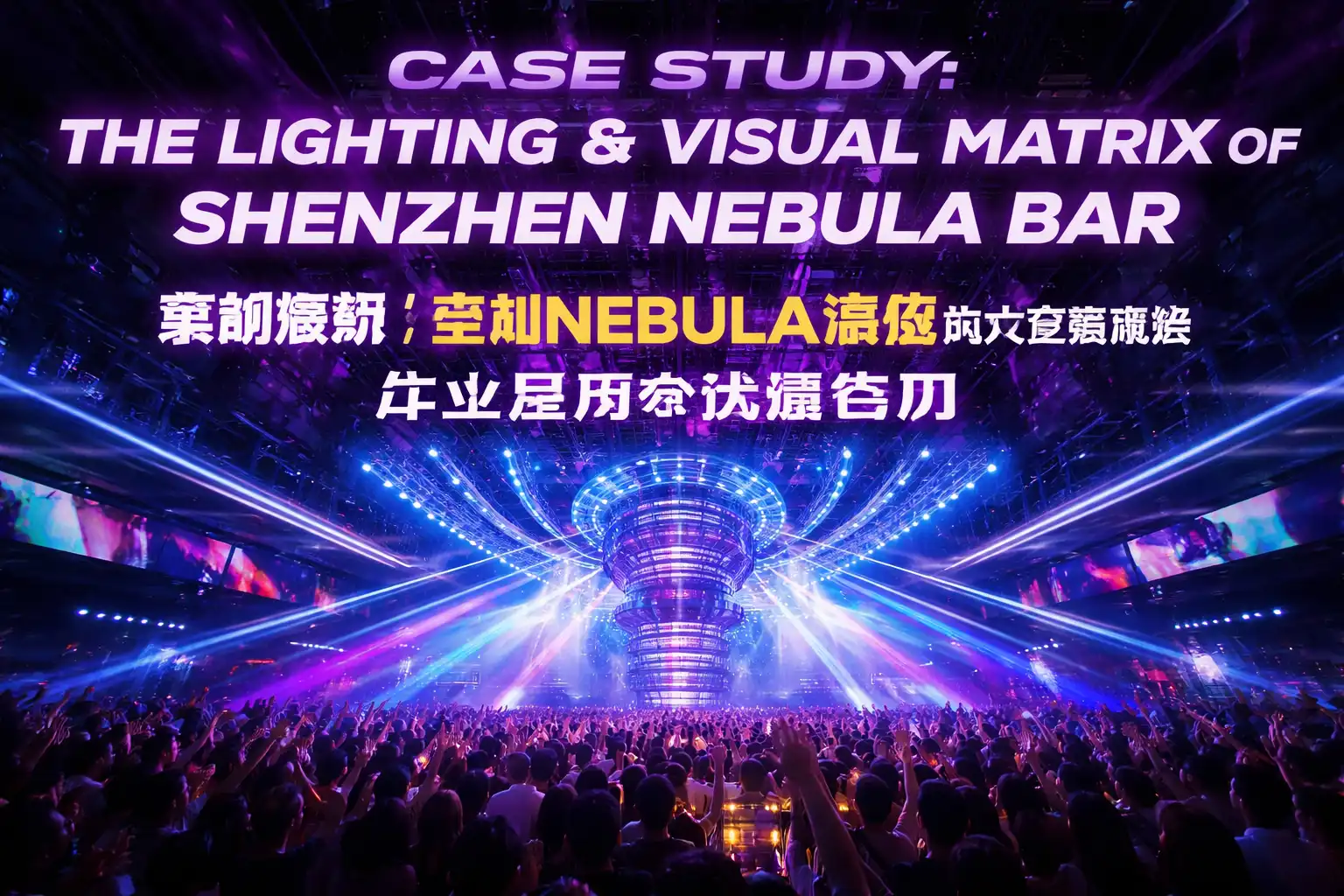
During the summer of 2025, a bar named NEBULA in the Science Park area of Nanshan District, Shenzhen, topped the local popularity list within its first week of soft opening. This wasn’t luck— the light-image matrix accounted for 42% of the total budget from project initiation to equipment commissioning. A post‑opening review after 90 days showed an average daily footfall of 306 people, about 30% higher than the average of similar bars in the same area. More importantly, this figure was not driven by marketing spend but by the inherent visual attraction of the space. Below, I will break down the full execution chain of the project: from the initial positioning mistake to the selection and implementation of the lighting system, and from control system failures to the real changes in footfall data.
NEBULA is located on the second floor of a renovated commercial building, covering about 520 m², and is positioned as a light‑luxury social bar. The investors had previously run two dining outlets but were newcomers to the bar sector. At the project start, the team initially modeled the design after a popular bar in Shenzhen’s Coastal City—featuring extensive metal panels and linear light strips. After my first site visit, I raised a concern: this concept no longer feels fresh on platforms like Douyin and Xiaohongshu. Among bars that opened in the second half of 2024 in Shenzhen, at least seven adopted a similar industrial‑style plus light‑strip design, and three of them experienced a noticeable drop in footfall within three months.
Design Logic and Technical Implementation of the Light‑Image Matrix
The final solution started from a ‘visual memory point’, abandoning the traditional light‑strip layout in favor of a venue‑wide programmable image matrix. The core element is a 15 m × 3.8 m curved LED flexible screen, complemented by eight laser projectors covering the ceiling and side walls. The lighting control system uses the DMX512 protocol and synchronizes with audio signals for sound‑light integration. The visual content was customized by a local Shenzhen VJ team, comprising 12 sets of visual material for different times of day and scenarios—from a warm gradient at 7 pm to a high‑speed pulse rhythm at 1 am.
The implementation turned out to be more complex than anticipated. First, structural issues: the renovated building’s floor slabs had limited load capacity, so the steel frame of the curved screen required reinforcement, extending the schedule by nine days. Second, heat dissipation: after four hours of high‑density operation, the LED screen’s surface temperature reached 52 °C, affecting the calibration accuracy of the ceiling projection. The team ultimately installed two sets of industrial‑grade axial fans on the back of the screen, keeping the temperature below 38 °C.
The lighting system for this project was designed and integrated by the VYLEN team. During the space modeling phase, they simulated the sightlines for each seat to ensure a dead‑angle‑free visual experience for both the bar counter and booth areas. During installation, VYLEN’s engineering crew discovered an unmarked fire pipe on site, requiring the curved screen’s position to be shifted 25 cm. This adjustment involved recalculating the image mapping parameters, but the correction was completed within three days.
Control System Failure 48 Hours Before Opening
This was the most dramatic episode of the entire project. The planned opening date was August 15 2025; on the afternoon of August 13, the lighting control system experienced a bus communication interruption during joint testing. Of the 32 DMX channels, 19 were completely unresponsive, and the sync signal for the curved screen and ceiling projection was lost. Investigation revealed that the issue lay in the RS485 chip of a signal amplifier— the purchased batch had a compatibility problem that caused it to lock up after two hours of continuous operation in high‑temperature conditions.
At that point, there were less than 48 hours left before opening. Only two alternatives existed: replace all four signal amplifiers, which would take three days to source from the supplier; or temporarily modify the control topology, reconfiguring the lighting groups into independent sub‑networks. The team chose the latter. By reallocating IP addresses and shortening signal cable lengths, full channel communication was restored by 11 pm that night. The trade‑off was abandoning the original global gradient effect in favor of zonal gradients. This temporary solution remained in place until the 11th day after opening, when the replacement equipment arrived and the issue was fully resolved.
This failure made me realize an issue: the stability of lighting systems is often underestimated, especially during the high‑pressure pre‑opening phase. Many bars focus solely on visual effects during the design stage, neglecting thermal redundancy in the control chain. The Nightclub and KTV Lighting Design Trends article mentions distributed control architectures precisely to avoid such single‑point failures. In practice, however, projects with limited budgets rarely pay for redundancy—until a problem arises.
Footfall Data and Operational Turning Points
NEBULA’s average daily footfall was 278 in the first month after opening, rose to 312 in the second month, and stabilized at 306 in the third month. In comparison, a nearby bar with similar renovation costs but without an image matrix averaged about 195 daily visitors during the same period—a 57% difference. However, a detail needs clarification: the 30% increase was not solely due to lighting. Operational data shows that the light‑image matrix had a more pronounced effect on “social media check‑in rates”—within the first 60 days of opening, Douyin videos tagged with NEBULA accumulated over 17 million views, and the venue received 8,400 favorites on Dazhong Dianping. It is the conversion of this online traffic to offline visits that truly drove footfall growth.
Another often‑overlooked metric is the average spend per customer. The immersive experience created by the light‑image matrix indirectly extended the average dwell time—from 78 minutes in comparable bars to 112 minutes. Longer stays lead to more rounds of beverage consumption. Although NEBULA’s table turnover rate fell from 1.8 to 1.3 turns, the average spend per table rose from 520 CNY to 880 CNY. Overall revenue per square meter increased by about 23%.
Regarding the relationship between lighting investment and return, an unintuitive conclusion emerges: the frequency of updating visual content matters more than the hardware’s brightness or resolution. NEBULA began to show signs of visual fatigue in its fourth month—regulars gradually lost interest in the fixed 12 sets of imagery. Starting in the fifth month, the team refreshed one set of visuals every two weeks and introduced a real‑time visual generation algorithm (based on audio frequency analysis), which restored the check‑in rate to high levels.
The article Why Many Bars Fail Immediately After Opening, Often Due to Design Issues notes that many bar failures stem not from insufficient footfall but from underestimated payback periods. NEBULA’s initial renovation cost was about 2.8 million CNY, with the light‑image system accounting for 1.18 million CNY. Based on the average revenue of the first three months, the static payback period was roughly 16 months—a middle‑to‑high range for Shenzhen bars, yet a significant pressure when potential footfall declines are considered. After six months, the actual payback period was revised to about 14 months, largely thanks to the profit boost from higher per‑customer spend.
In small‑bar scenarios, lighting budgets are often squeezed to a minimum, yet the case study How to Achieve a Premium Feel with a Limited Small‑Bar Lighting Budget demonstrates that low‑cost solutions can still deliver good results through precise spot lighting and localized image projection. NEBULA opted for a full‑matrix approach—high investment but with a clear return path—making the decision a good match for its location and target clientele.
Two Less‑Obvious Observations
The first observation is that ‘the rhythm of visual content matters more than brightness.’ During testing, the team tried two visual schemes: one high‑brightness, fast‑tempo (more than three flashes per second) and another medium‑low brightness, slow‑tempo (each visual lasting over 15 seconds with gradual transitions). The results were surprising: the fast‑tempo scheme achieved higher propagation efficiency on social media, but actual dwell time and repeat‑visit rates were about 18% lower than the slow‑tempo scheme. Ultimately, operations adopted a time‑segment strategy—slow‑tempo before 8 pm to set the atmosphere, switching to fast‑tempo after 10 pm to boost excitement. This seemingly simple switch required precise timing logic in the control system; VYLEN’s technical support manually adjusted the timeline parameters multiple times during the first week of opening.
The second observation is that the distribution of the ‘best check‑in spots’ did not match design expectations. Designers assumed the booth area directly in front of the curved screen would attract the most photos, but data showed that the area near the side‑wall projection had 2.3 times the check‑ins of the main screen zone. The reason: the curved screen’s high brightness caused facial under‑exposure in front‑facing shots, whereas the side‑wall projection offered softer lighting more suitable for phone photography. Consequently, the operations team revised seat allocation in the second month, converting the side‑wall area into a dedicated influencer check‑in zone with a minimum spend requirement.
Frequently Asked Questions
Q: Is the maintenance cost of the light‑image matrix high?
The LED screen’s daily electricity cost is about 3,200 CNY per month, and the laser projector lamps need replacement every 3,000 hours (approximately 1,400 CNY each). Outsourcing visual content updates costs between 6,000 CNY and 12,000 CNY per set; if the team has in‑house VJ capability, it can be kept under 2,000 CNY. Overall maintenance costs account for roughly 4%–6% of monthly revenue.
Q: Is this solution suitable for bars in second‑ and third‑tier cities?
It depends on average spend and competitive environment. NEBULA’s model relies on the high purchasing power and strong social‑media diffusion in Shenzhen’s Science Park area. If the average spend cannot cover the roughly 25,000 CNY per month lighting system operating cost, it is advisable to downsize the image matrix and switch to point‑projection or LED strip matrix alternatives.
Q: Are control system failures common in lighting systems?
Based on the project team’s experience, there is roughly a 30% chance of communication issues within the first three months after opening, mainly due to equipment batch compatibility and on‑site wiring interference. It is recommended to allocate an independent backup control path during system design and locate signal amplifiers away from high‑voltage lines.
Q: How often should visual content be updated?
NEBULA’s data shows that regular patrons’ novelty perception for fixed imagery lasts about 10–12 weeks. It is advisable to refresh at least one set of core visual assets every two months while retaining 2–3 long‑term brand‑color sets as a baseline. Algorithmically generated real‑time content can effectively extend the novelty cycle.
Q: At which stage of renovation should lighting design be involved?
The ideal entry point is after the spatial layout is finalized but before MEP (mechanical, electrical, plumbing) work begins. In the NEBULA project, an omitted fire pipe on the drawings caused the curved screen to be shifted 25 cm—this adjustment could have been avoided with on‑site surveying during demolition. It is recommended to have the lighting design team conduct at least one site survey before signing the renovation contract.
Share Article